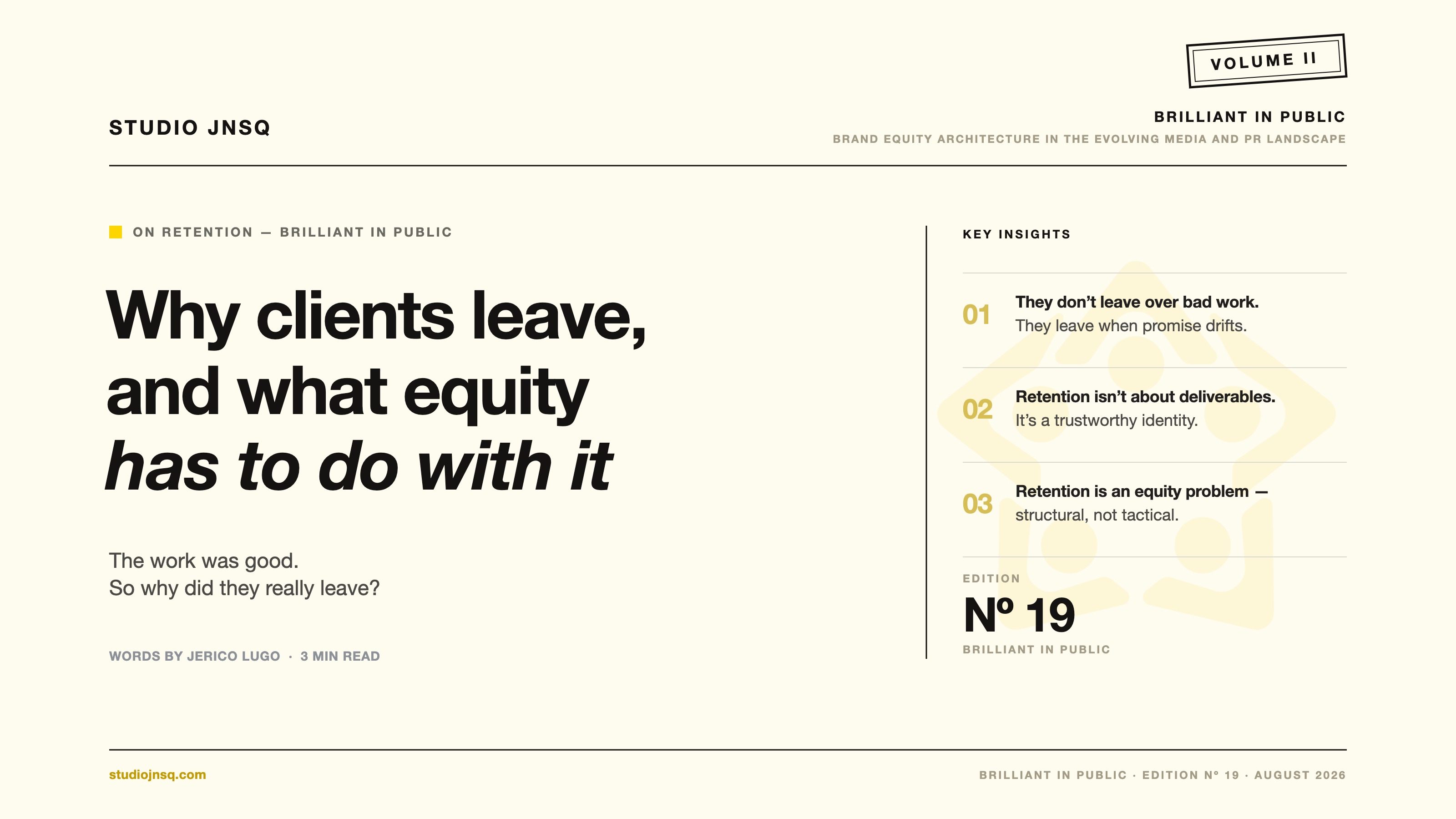
A client you have worked with for two years just left. The work was solid, the results were there, and they even said they were happy. But a competitor offered something shiny, and your client did not hesitate. That is not a pricing problem or a service problem; it is an equity problem. I have seen this pattern more times than I can count, both with clients I work with and in my own practice before I understood what was happening. The exit feels sudden, but it is not. It is the result of a slow accumulation of small equity deficits: moments where the brand experience did not reinforce the trust, moments where the relationship was maintained by inertia rather than conviction. When something better comes along, there is nothing holding the client in place.
Why do clients leave even when the work is good?
Good work is table stakes. Your client hired you because they believed you could deliver, and you did. But delivery alone does not build the kind of equity that keeps a client when alternatives appear. What keeps clients is the sense that your brand represents something they cannot get elsewhere.
The brands I have seen clients struggle to leave are not always the ones doing the most technically impressive work. They are the ones with the clearest identity, the most consistent communication, and the strongest sense of what they stand for. Deloitte's research on brand trust confirms the pattern: 88% of customers who trust a brand will buy again, and trusted companies outperform peers by up to 400% in market value.
When a client considers leaving a high-equity brand, they are not leaving a service provider. They are leaving something that has become part of how they think about their own work.
What makes some brands impossible for clients to leave?
The brands that clients cannot leave have built what I call compounded trust: a layered accumulation of kept promises, consistent identity, and reliable delivery that becomes structurally embedded in how the client operates. It is not one great project or one strong relationship; it is the consistent architecture of a brand that delivers on its promises at every touchpoint over time.
The practical architecture of impossible-to-leave brands comes down to three things:
Consistency. The identity, the communication, and the delivery are all aligned with the same promise. Kantar's research on brand experience gaps shows that brands whose customer touchpoints are aligned with their brand promise are significantly more resilient than those that are not.
Presence. They maintain visibility in the client's professional world even between projects. You are not a vendor; you are a trusted presence in their ecosystem.
Understanding. They make the client feel not just served, but seen. When those three things are in place, leaving becomes a much harder decision than switching to a competitor with a better pitch.
How do you build equity strong enough to retain clients long-term?
Start by auditing the gap between what you promise and what you deliver. Not at the project level, but at the brand level: every touchpoint, every communication, every moment a client encounters you or your work. The MAD™ diagnostic was built for exactly this, to show where your brand architecture has gaps that erode trust over time, even when individual deliverables are strong.
Then look at your presence between projects. The brands that retain clients most effectively are the ones that stay relevant even when there is no active engagement. That means content, communications, and a consistent point of view that clients encounter and value outside of the work itself.
Finally, be honest about your positioning. The clearest brand identities are the easiest to stay loyal to, because the client always knows what they are getting. If your positioning is vague, clients cannot build a strong attachment to it because there is nothing clear enough to attach to. Bain's research on customer retention puts the financial case plainly: increasing retention by as little as 5% can boost profits by as much as 95%.
Brand equity retention starts with brand equity clarity, and clarity starts with a diagnostic, not a rebrand.
"The exit feels sudden, but it never is. It is the result of a slow accumulation of small equity deficits. When something better comes along, there is nothing holding the client in place. The fix is structural: build the architecture before the next competitor knocks." — Jerico Lugo, Founder, Studio JNSQ
Brand equity retention starts with brand equity clarity, and clarity starts with a diagnostic, not a rebrand.
Audit your last three client departures.
For each one, write down what they said when they left, and then write down what you think happened. Now look at the gap between those two lists. If the stated reasons are about price or timing but the real reasons are about trust, communication, or feeling undervalued, you are looking at a brand equity leak, not a service delivery problem.
— Jerico Lugo, MCIPR