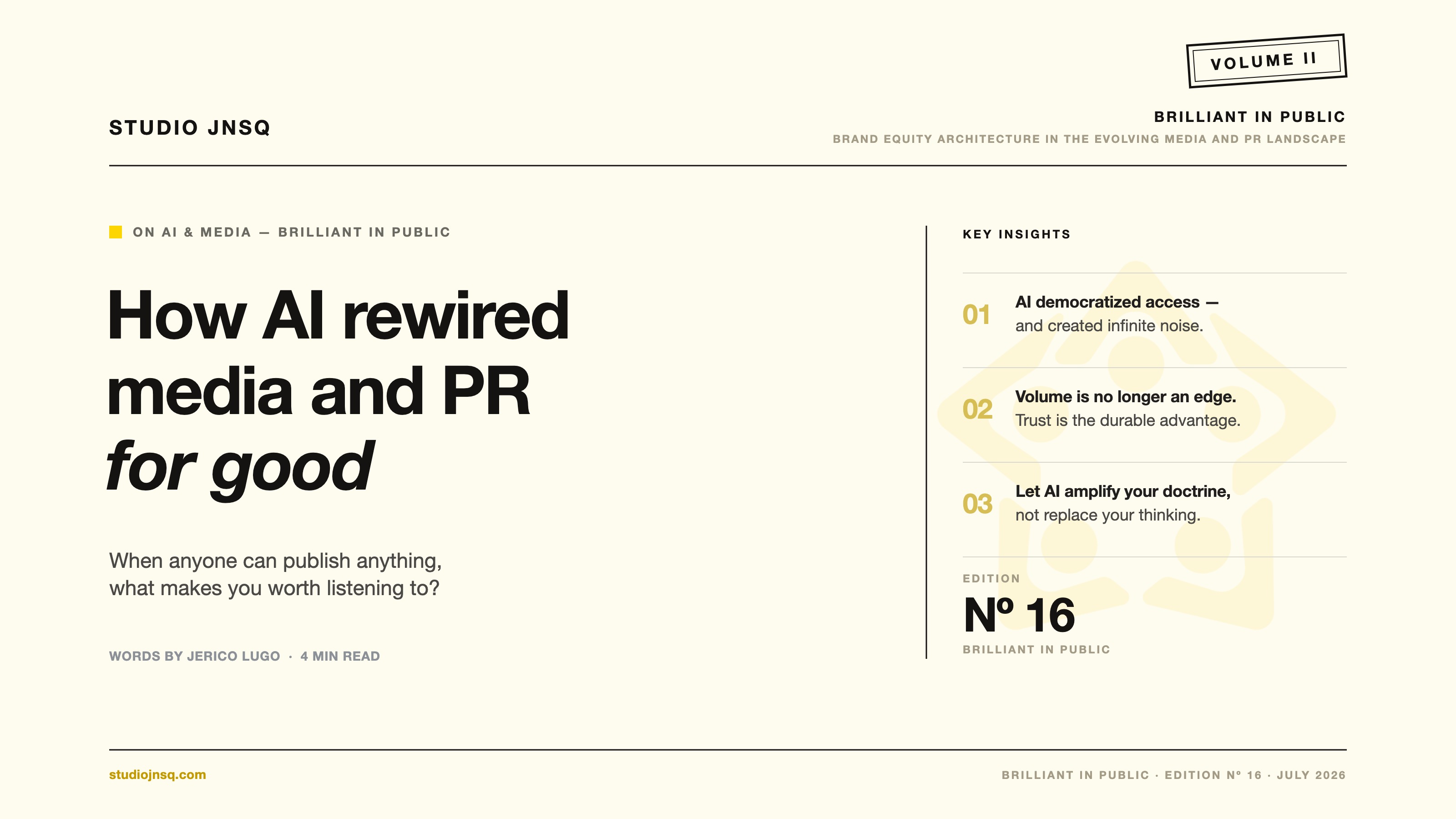
AI did not set out to disrupt PR and media. It did not need to. The moment anyone could generate thousands of articles, press releases, and social posts at near-zero cost, the entire value proposition of traditional media strategy changed overnight. Not because the tools replaced practitioners, but because they drowned them.
What did AI change about media and PR?
For most of PR history, access was the advantage. You needed relationships with editors, a network of journalists, a PR agency with the right connections. The cost and friction of getting placed in credible media kept the bar high and the volume manageable. That model assumed scarcity. AI eliminated the scarcity.
Kantar's 2025 Marketing Trends research reveals the scale of this shift: over 60% of consumers now worry that generative AI could lead to fake or misleading advertisements, and 43% say they do not trust ads that are AI-generated. The traditional PR playbook, built around pitching, placement, and earned media, was designed for a world where everyone had a small platform. Now everyone has a megaphone and everyone preaches their own doctrine.
The other shift is in measurement. PR was historically hard to quantify, which made it easy to deprioritize. But the numbers were always there; they were not being connected to the right outcomes: CAC, MRR, LTV. McKinsey's research on brand-driven growth confirms that the strongest brands consistently outperform on financial metrics, and those financial effects trace directly back to trust.
Why does AI make brand equity architecture more important, not less?
When noise is infinite, trust becomes the only differentiator that compounds. Paid media drives reach; it does not build trust. And reach without trust is rented attention that resets every time the budget pauses.
Think about what a buyer encounters in 2026: dozens of thought leaders making the same claims, dozens of agencies producing identical-sounding content, and an AI-powered content machine that makes it trivially easy for anyone to look like an authority. In that environment, the question shifts from "who has the most content?" to "who do I trust?"
Brand equity architecture answers that question by building the structural conditions for trust, credibility, market authority, and demand that compound over time rather than resetting after every campaign cycle. Deloitte's Connected Consumer Survey reinforces this: consumers are demanding transparency and authenticity from brands precisely because AI has made manufactured credibility effortless.
AI gave everyone a megaphone. Brand equity architecture gives you the signal worth amplifying.
How do you use AI as part of your architecture instead of against it?
The framing is simple: AI amplifies what already exists. If your brand doctrine is clear, AI can scale your message. If your brand doctrine is vague, AI will scale the vagueness.
The practical version looks like using AI to research, draft, and distribute content that is rooted in your brand's actual positioning, not generic content that could belong to anyone. The architecture comes first; the AI accelerates what the architecture produces.
Build the system correctly, and AI becomes a force multiplier. Build it incorrectly, or skip it entirely, and AI produces more noise in your name. Systems, once set up, run unless there are new disruptions. That is the right mental model for AI in brand equity work.
If your content strategy relies on volume, AI has already commoditized your advantage. The brands that will compound in a post-AI media landscape are the ones with a clear doctrine, a trust architecture, and the discipline to let AI amplify rather than replace their positioning.
"AI can produce a thousand articles overnight. It cannot produce a single reason for the market to trust you. That reason is built through architecture, not automation." — Jerico Lugo, Founder, Studio JNSQ
If you want to know where your brand stands in the post-AI media landscape, run the MAD™ diagnostic to see how credibility, visibility, and demand map to your current positioning. For revenue-stage companies, the RVF™ diagnostic will show you how equity translates to exits and pricing power.
Search your own company name on Google, then search the problem you solve.
Compare what comes up. If your name brings results you control, good. If the problem search brings up ten competitors and AI-generated articles before you appear, your visibility is rented, not owned. Now ask: of the content you published last quarter, how much was built to compound trust versus how much was built to generate impressions? Write down the ratio. That number is your starting point.
— Jerico Lugo, MCIPR