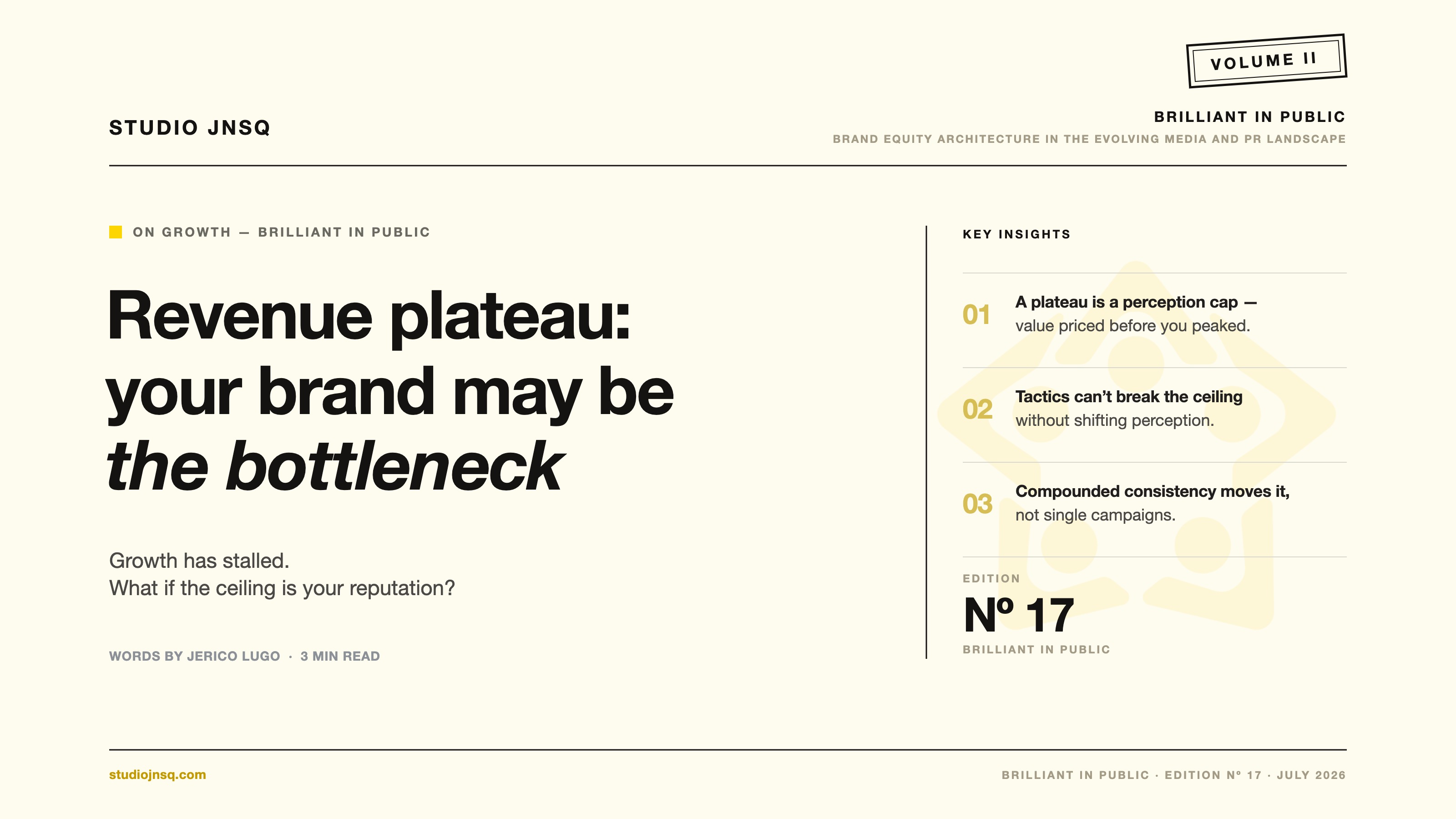
Revenue hit a ceiling and you cannot figure out why. You have tried new channels, new offers, new hires. Everything performs fine on paper but the number will not move. The bottleneck is not your marketing or your product; it is your brand. This is the pattern I see most often with founders who come to me after two or three years of solid growth followed by a plateau they cannot explain. The business is well-run. The team is capable. The product is genuinely good. But the number sits there, month after month, stubbornly refusing to move past a certain point. And the harder they push, the more expensive staying flat becomes. Bain's research confirms the pattern is widespread: 42% of leaders missed growth targets in 2025, up from 32% in 2024, and most struggle to clearly define why customers should choose them.
Why do revenue plateaus happen even when marketing and sales look right?
When a business is in its early growth phase, revenue follows activity fairly predictably. You do more outreach, you close more deals. You run more ads, you get more leads. The relationship between input and output feels direct, and that directness can mask what is driving the growth: the novelty of a new market presence, the enthusiasm of early adopters, and the natural spread that happens when something new enters a space.
Once that early momentum settles, the market has formed an impression of who you are and what you are worth. That impression does not automatically update because your capabilities have grown. If the market sees you as a mid-tier provider at a certain price point, the ceiling is set at that tier regardless of how much better you have gotten. Every new campaign you run is selling into that pre-formed perception.
The plateau is not a marketing problem because more marketing activity does not change the perception; it reinforces it.
What you need to change is the underlying architecture of how the market understands your value.
How does weak brand equity create a revenue growth ceiling?
Brand equity is the value the market assigns to your name, independent of your product or service. When brand equity is low or stagnant, the market's willingness to pay is capped at whatever they believe the brand is worth, not what the work is worth. That ceiling is invisible until you try to push through it, at which point it becomes extremely visible.
Kantar BrandZ research frames this clearly: a brand's equity in the minds of consumers is a game-changing multiplier in the calculation of a brand's value. The more a brand has been strengthened, the better it navigates market storms, the faster it grows, and the more valuable it is. A brand equity system that has not been architected deliberately will default to whatever the market decides to assign it. Once that assignment is made, it runs on autopilot, reinforcing itself with every touchpoint, unless you introduce a deliberate disruption.
That disruption is not a rebrand, and it is not a new campaign. It is a strategic shift in how you position your value, what signals you send to the market, and which credibility markers you build toward. Done consistently over time, those shifts compound into a new market perception that supports a higher price point and a wider pipeline.
What breaks a business through a brand equity ceiling?
The phrase I use with clients is compounded consistency: small, deliberate moves that accumulate into a shift the market feels before it consciously understands it. You do not announce that you are moving upstream; you build the evidence that places you there. Case studies from a higher-tier client. A media feature in a publication your target market reads. A partnership that signals proximity to the space you are trying to occupy.
None of those things alone move the needle. But together, over six to twelve months, they shift the signal the market receives about who you are. And when the signal shifts, so does the ceiling. McKinsey's research on brand-driven growth shows that companies with a clear and consistent value proposition achieved 19% revenue growth in 2025, compared with 12% for those without one.
The MAD™ diagnostic is designed to show exactly where that ceiling is coming from: which of the four facets and the centering point of market authority is suppressing your brand equity and keeping the revenue plateau in place. Identifying the specific gap is what makes the work efficient; otherwise you are guessing, and guessing is expensive.
If your revenue has flatlined despite increased effort, the constraint is not in your execution. It is in how the market perceives your value. That perception is your brand equity, and it can be architected deliberately.
"Revenue plateaus are not solved by doing more of what got you here. They are solved by changing what the market believes you are worth. That belief is brand equity, and it is the most undermanaged asset on most balance sheets." — Jerico Lugo, Founder, Studio JNSQ
The MAD™ diagnostic is designed to show exactly where that ceiling is coming from: which of the four facets and the centering point of market authority is suppressing your brand equity and keeping the revenue plateau in place. Identifying the specific gap is what makes the work efficient; otherwise you are guessing, and guessing is expensive.
Pull up your revenue numbers for the last twelve months. Plot them.
If the line is flat or gently rising despite increased effort, you are at the ceiling. Now answer this: if a potential acquirer looked at your brand tomorrow, independent of your financials, what would they see? Write down three things your brand is known for in the market. If you struggle to name three, the plateau is not a growth problem. It is a brand equity problem.
— Jerico Lugo, MCIPR