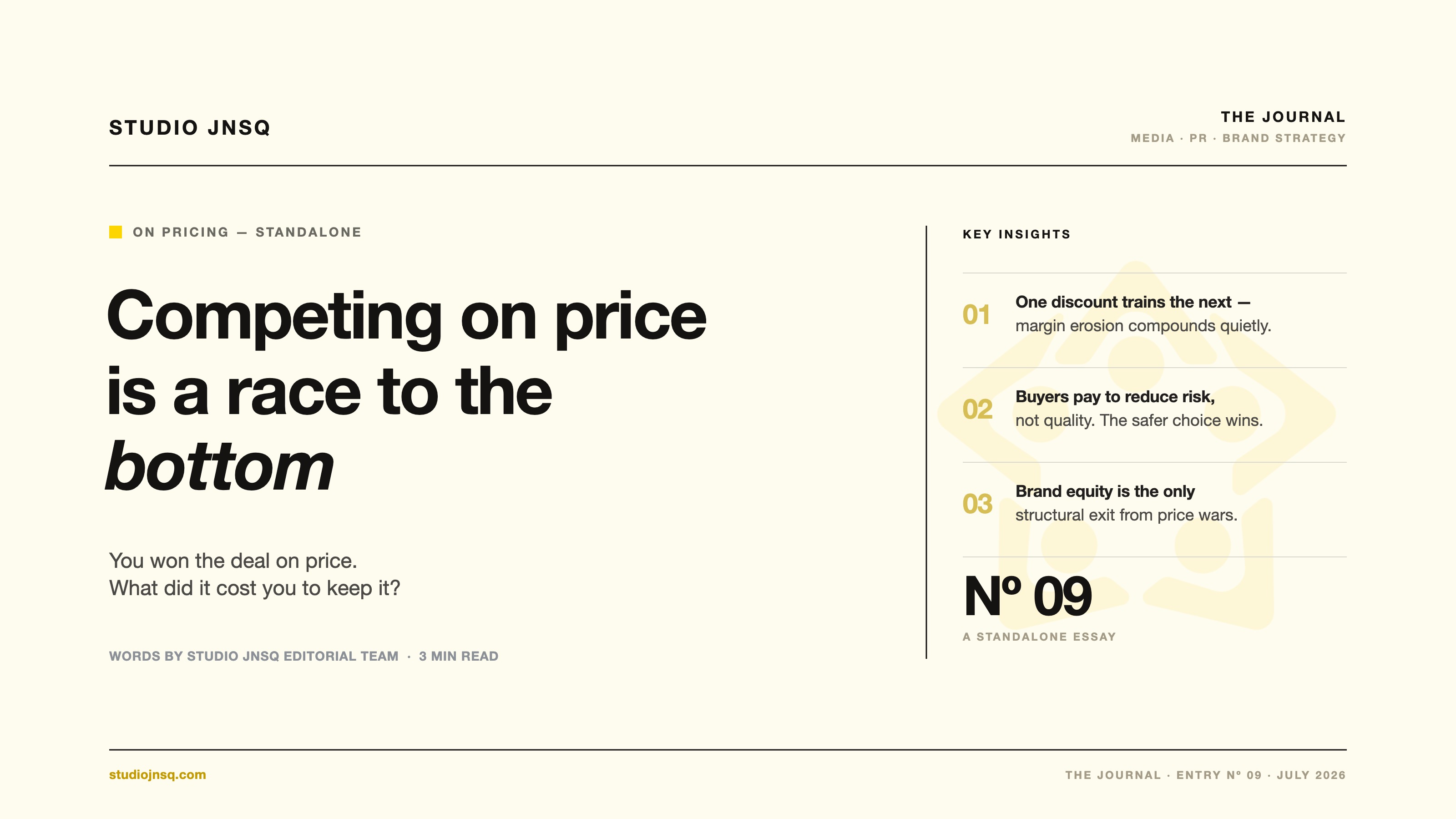
You dropped your price to win a deal. The client took the discount and came back next quarter expecting the same. Now your margins are thinner, your pipeline is trained to negotiate, and your competitor is still charging double. This is what a race to the bottom looks like from the inside.
Why does lowering your price never solve the pricing problem?
The math is the first thing to understand. If you earn 30% margins and you cut your price by 10%, you need to win 50% more volume to break even on profit. Most businesses never run that number before they discount.
The cycle is the second thing. The moment you give a discount, you signal two things to that client: that your original price was negotiable, and that you needed the deal. Both of those signals stick. They come back expecting the same flexibility. They refer others with the same expectation baked in. You have not solved a competitive problem; you have built a pipeline that negotiates by default.
The third thing is what undercutting does to your category position. Every time you drop below the market rate, you confirm to the market that you belong below it. Interbrand's research on brand and share price demonstrates a powerful connection: companies that treat their brand as a revenue generator rather than a cost center consistently outperform on valuation. Competitors who hold their price are quietly building category authority while you are quietly losing it.
What makes buyers willing to pay a premium for the same product?
The honest answer is not quality. Buyers often cannot evaluate quality before they buy; they are not experts in your craft. What they can evaluate is risk.
Think about the decision a buyer is making when they hire you. They are putting their time, budget, and in many cases their own credibility on the line. If it does not work, they have to explain that to someone. The premium provider does not deliver better work; they make the decision feel safer. There is a track record, a clear position in the market, a reputation that makes the buyer say: if this goes wrong, at least I hired the best-known firm in the space.
That is category authority. It is not about being better. It is about being the defensible choice. Interbrand's Best Global Brands 2024 shows that the most valuable brands in the world are the ones that have built deep, meaningful relationships with customers that drive loyalty and advocacy. That authority is built through brand equity, not through campaigns or discounts.
Price is what you charge. Value is what the market believes you are worth. When those two numbers diverge, the market always wins.
How do you stop competing on price and start competing on brand equity?
You stop competing on price by making price a secondary consideration. That happens when the market can see a clear, credible difference between you and the alternatives; not a feature difference, not a delivery-time difference, but a positioning difference. One that lives in how the market perceives your authority.
This is what brand equity architecture is designed to do. Not redesign your logo, not run a new ad campaign, but build the underlying structure that makes your brand the obvious, defensible choice in your category. Once the market understands what you stand for and believes you own it, the conversation shifts from price to fit. McKinsey's research on brand-driven growth confirms this: the strongest brands consistently outperform on financial metrics because they have moved the competitive conversation beyond price.
The first step is knowing where you stand across the dimensions the market uses to evaluate authority. The MAD™ diagnostic was built for exactly that.
If your pipeline is negotiating your price, the problem is not your price. The problem is that the market does not yet see a reason to pay it. Brand equity architecture builds that reason.
"The brands that command premiums are not the ones with the best product. They are the ones the market has decided are worth the risk. That decision is built through equity, not through proof points alone." — Jerico Lugo, Founder, Studio JNSQ
The first step is knowing where you stand across the dimensions the market uses to evaluate authority. The MAD™ diagnostic was built for exactly that.
— Jec