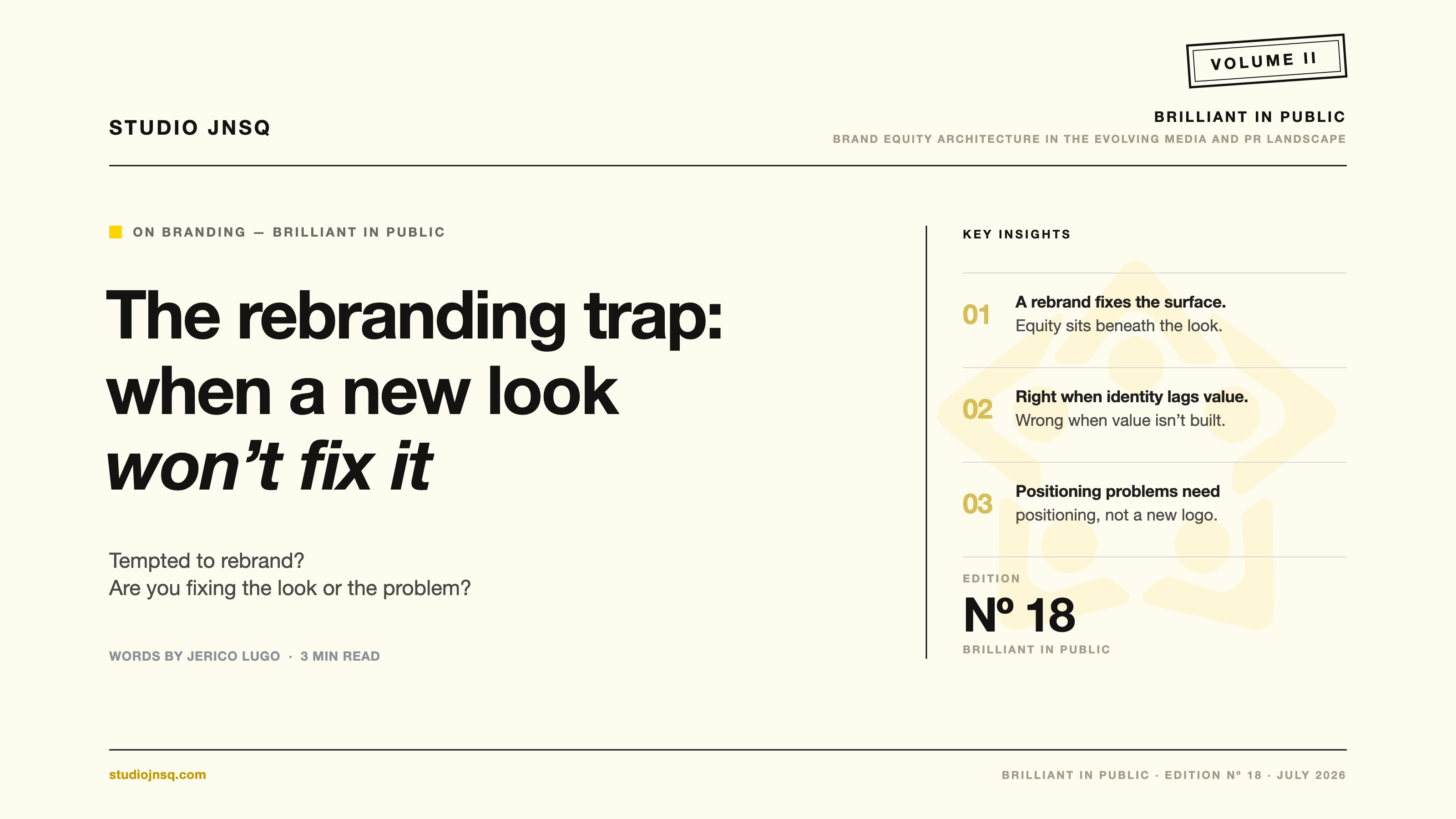
You spent six figures on a rebrand. New identity, new website, new messaging. The launch went well; the team loved it, clients noticed the change, social media engagement spiked for a week. Six months later, nothing material has changed. Revenue is the same. Client retention is the same. Your pricing power has not moved. This is not a story about bad design or failed execution. The new brand probably looked great. The problem is that the rebrand solved a different problem than the one the business had.
Why do rebrands fail to move the numbers on brand equity?
Because branding is the surface layer, and most revenue and retention problems live underneath it. Branding is the centering point of the entire brand system: it holds the visual identity, the messaging, and the aesthetic together in a coherent form. When branding works, it communicates value efficiently. But it can only communicate what the brand has built.
If the underlying brand equity is weak, if the market does not yet trust you, does not yet see you as credible, does not yet have a specific reason to want you over the alternative, then a new visual identity communicates that weakness more clearly, not less. You have given a more professional face to an unresolved strategic problem. HBR's analysis of failed rebrands demonstrates this pattern: when a rebrand is introduced without substantive change, consumers detect the gap and trust erodes further.
If you are serving excellent gelato on a rainy street in November, the problem is not the cup design. The problem is the context.
Designing a better cup does not change the weather or move you to a location where people want gelato. A rebrand without underlying equity work is the same kind of move: it optimizes the presentation without changing the conditions that determine whether people want what you are offering.
When is a rebrand the right move, and when is it a distraction?
A rebrand is the right move when your visual identity and messaging have genuinely fallen behind the value you have built. If you have grown significantly, expanded your client base, moved upstream in pricing, and developed a clearer sense of your buyer, but your brand still looks like it did when you were starting out, there is a real misalignment. In that case, a rebrand brings the surface layer into alignment with equity that has already compounded.
A rebrand is a distraction when the problem is strategic rather than aesthetic. If you are struggling to differentiate, if buyers are not clear on why you over a competitor, if your pricing power is flat despite years in market, those are positioning and credibility problems. Kantar's research on brand strategy reinforces this: the brands that grow sustainably are the ones that invest in meaning and differentiation, not surface-level refresh.
The diagnostic question is simple: does your current visual identity misrepresent the value you have already built, or does your business not yet have enough built value to justify a new surface layer? The answer tells you whether a rebrand is a strategic alignment move or a strategic avoidance move.
What should you do instead of rebranding?
Start with a diagnostic. Understand which specific components of your brand equity are underperforming. Is it demand, the market is not actively seeking you? Is it credibility, buyers have no third-party validation? Is it market trust, your behavior has been inconsistent enough that buyers hesitate to commit?
Once the gap is identified, the work is targeted. If it is a credibility gap, you build case studies, pursue recognition, and cultivate editorial coverage in the venues your buyers trust. If it is a demand gap, you sharpen positioning and invest in long-term signals. If it is a trust gap, you audit the consistency of your brand behavior and eliminate friction points sending mixed signals.
When that work is done, if the visual identity needs updating, a rebrand makes sense. It becomes a celebration of what you have built, not a hope that the new look will build it for you. The MAD™ diagnostic was designed for exactly this sequence: diagnose first, build equity, then align the surface layer.
If your rebrand did not move revenue or retention, the problem was never the branding.
The mistake is diagnosing a strategic equity gap as a visual identity problem. Rebranding without fixing the underlying trust, credibility, or market position means you have optimized the presentation of a weak offer. The cost shows up in stalled growth, flat pricing power, and lower valuation multiples when you go to exit.
- Smaller companies use brand equity architecture to build the trust and credibility structure that makes pricing power and client retention possible before they spend on rebranding.
- Bigger companies use it to diagnose whether a rebrand will actually unlock the next valuation threshold or just make the current plateau look better.
"Rebranding without brand equity work is like framing a house that has no foundation. The frame looks impressive until the first storm arrives." — Jerico Lugo, Founder, Studio JNSQ
What this means for your business
Before your next brand investment, run the HBR Brand Report Card against your current position. If the gaps are in equity, not aesthetics, a rebrand will not close them. Fix the architecture first.
Before your next brand investment, answer three questions in writing.
(1) What specific business outcome am I expecting this to change? (2) How will I measure that change in 90 days? (3) Is this a branding problem or a brand equity problem? If your answers are vague, the investment will be too. Most failed rebrands start with unclear answers to question three.
— Jerico Lugo, MCIPR