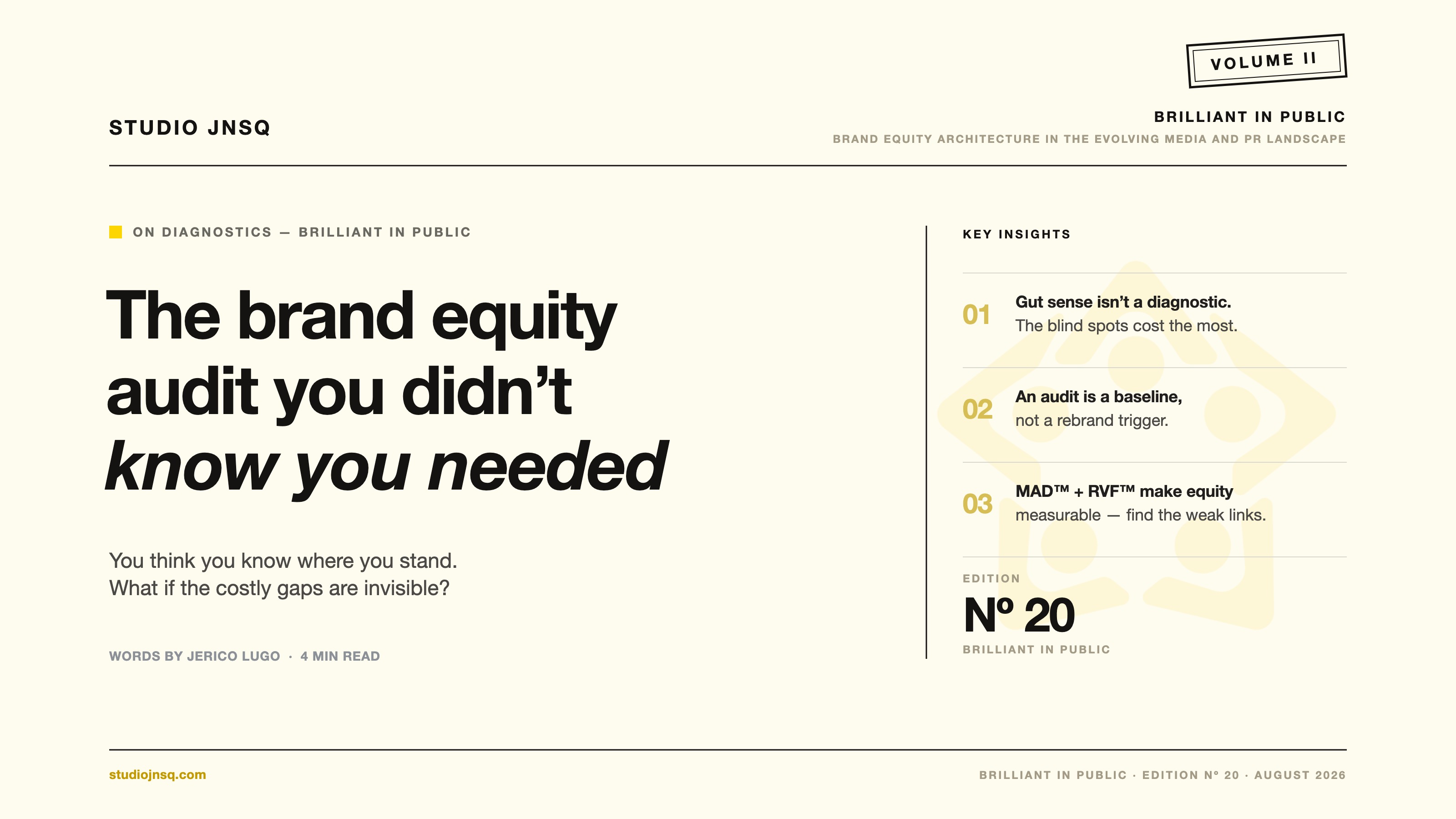
In the last edition, we talked about why clients leave and what brand equity has to do with the relationships you assumed were solid. This one is the practical follow-up: a systematic checklist for auditing where your brand stands, not where you think it stands.
Most founders I work with think they know where their brand stands. They have a sense, a gut feeling, sometimes a few metrics they check. But when I ask them to walk me through it systematically, the gaps become obvious fast. This is not a rebrand checklist. It is not a marketing audit. It is a brand equity diagnostic: a structured way of looking at the architecture of your brand and identifying where the gaps are between what you intend and what the market experiences. Kantar's brand equity research shows that the strongest brands consistently outperform on financial metrics because they measure and manage their equity structurally, not instinctively.
What should you check in a brand equity audit?
We need first to check where you are, not where you were, not where you want to be, but where you are presently. That principle drives the structure of the audit. It has five areas, which correspond to the four facets and the centering point of the MAD™ diagnostic.
Demand: Is there evidence of organic inbound interest in what you do? Are you being found, referenced, recommended, or sought out by people who did not previously know you? Demand in the brand equity sense is not the same as pipeline. It is the market's active pull toward your brand.
Credibility: What does the market see when it looks for evidence that you can do what you say you can? This includes media presence, publications, third-party validation, and verifiable track record. If the only evidence of your expertise is on your own website, your credibility facet is weaker than you think.
Visibility: Are you showing up where your target market is actively looking? Not on social media broadly, but in the specific channels your buyers use when they are in decision-making mode. You can be very active on platforms where your buyers are not, and completely invisible in the places that matter.
Branding: Is your visual and verbal identity consistent, clear, and aligned with the position you want to hold in the market? Branding is the layer most founders over-invest in early and under-align with their actual equity strategy.
Market Trust: What is the market saying about you when you are not in the room? Trust is the cumulative result of all the other facets, and it is the hardest to build and the easiest to erode.
Where do most brands have blind spots?
Credibility is the most common blind spot. Founders consistently overestimate how visible their expertise is to people who have not already worked with them. Kevin Keller's Brand Report Card in Harvard Business Review identified ten characteristics the strongest brands share, and a consistent finding is that the gap between internal perception and external reality is where most brand value leaks.
Market Trust is the second most common. It is easy to confuse client satisfaction with market trust. Your existing clients may trust you completely. But market trust extends beyond the people you have already worked with; it includes the perception of people who have encountered you tangentially. That broader trust is built differently and needs to be audited separately.
The third blind spot is the gap between Branding and actual brand equity. Many founders invest heavily in visual identity and messaging and assume that the branding work translates into equity. It does not automatically. Branding is the surface layer. Equity is the architecture underneath it. A beautifully designed brand with weak credibility, low demand, and fragile market trust has strong branding and weak equity.
The audit forces you to separate what you intend from what the market experiences.
What do you do once you find brand equity gaps?
You prioritize by leverage, not by urgency. The most urgent gaps are not always the highest-leverage ones. The MAD™ diagnostic is designed specifically to help you identify which gaps have the highest impact on your overall market authority score. Interbrand's brand strength methodology similarly prioritizes the factors that drive the most defensible long-term value, not the ones that are most visible on the surface.
Once you have your priority order, build a structured action plan for each gap: specific, measurable actions with a timeline that reflects both urgency and compounding. Some facets, like Visibility, can show movement in weeks. Others, like Market Trust, build over months and years. Your plan needs to account for both timelines simultaneously.
"Most founders audit everything except the one thing the market uses to price them. The brand equity audit is where assumption ends and architecture begins." — Jerico Lugo, Founder, Studio JNSQ
Run the diagnostic again at a defined interval, typically six months, to measure movement. Brand equity auditing is not a one-time exercise; it is a recurring practice. The brands that build durable equity are the ones that audit consistently and adjust continuously.
Score yourself honestly on these five questions, one to five.
(1) Can the right people find you without a referral? (2) Can you prove your track record to someone who has never heard of you? (3) Does the market understand what you stand for in under five seconds? (4) Would clients recommend you publicly, not privately? (5) Does inbound keep coming when you stop outreach? Add your scores. Under 15 means the audit told you where to start. Take the MAD™ diagnostic to see the full picture.
— Jerico Lugo, MCIPR