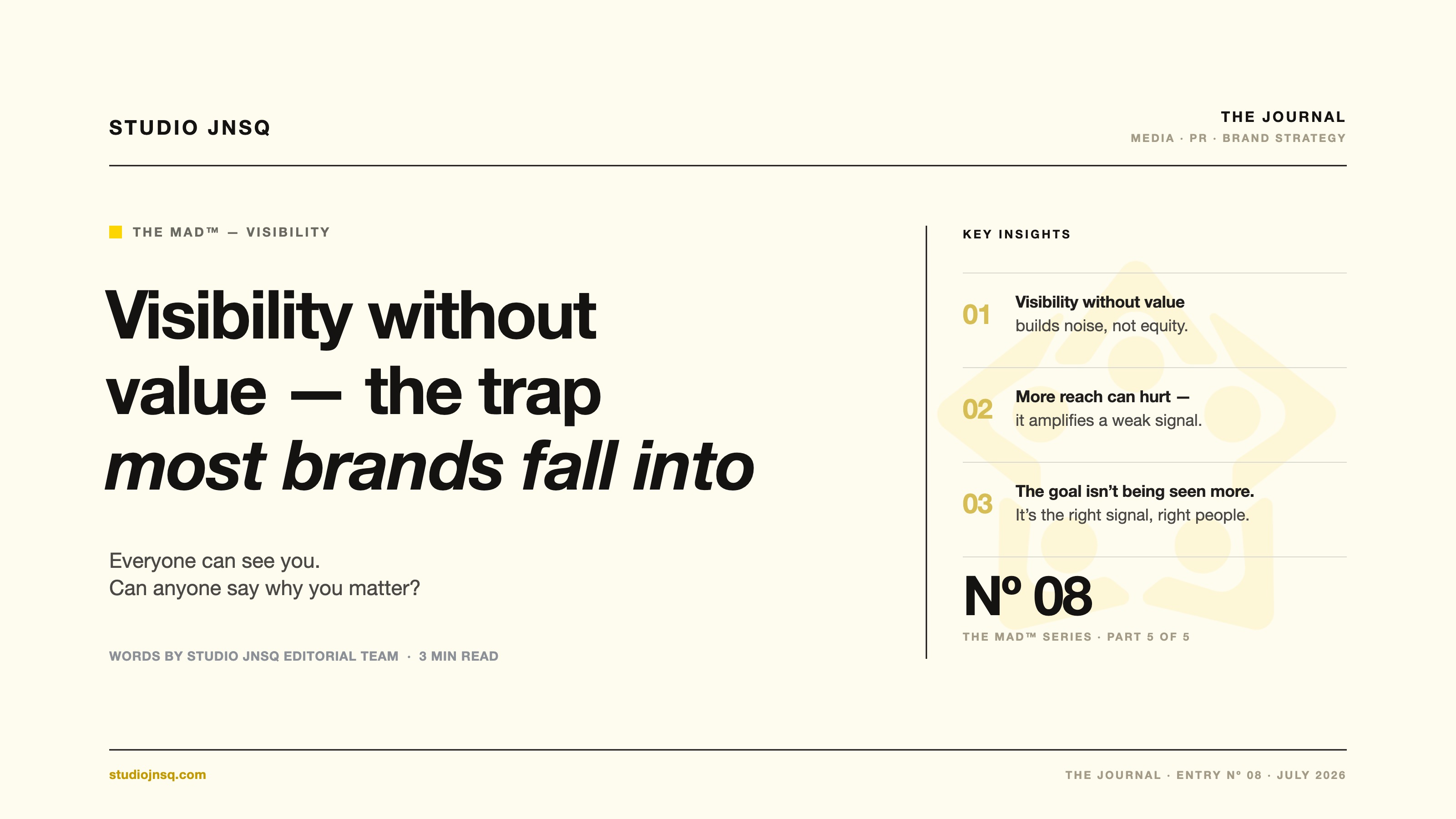
You are everywhere. Top of search results, consistent social presence, podcast appearances, newsletter mentions. But your close rate has not improved, your pricing power is flat, and you are still losing deals to less visible competitors. Visibility without value is the most expensive trap in brand building. It is expensive because you are paying for reach, in time, money, and attention, without generating the return that reach is supposed to produce. McKinsey's research on the consumer attention gap confirms the scale of this problem: while content volume has surged nearly 50% since 2022, the amount of time consumers spend consuming content has plateaued. The market has learned to see you as part of the background rather than as a signal worth paying attention to.
Why does more visibility sometimes make results worse?
Because visibility amplifies whatever signal your brand is already sending. If that signal is unclear, if your positioning is generic, if your value proposition sounds like everyone else in your category, then more reach means more people seeing a reason not to differentiate you from the crowd. You become visible and forgettable simultaneously.
There is also a trust dimension. When a brand is highly visible but does not deliver the depth the visibility implies, buyers notice. They have seen you everywhere, they engage with your content, they follow you. And then when they evaluate you as a vendor, the substance does not match the presence. That gap does not fail to close a deal; it actively erodes trust because the brand has overpromised through its visibility and underdelivered through its actual value signal.
The brands with the most powerful market authority are often not the most visible brands. They are the most valued. Their visibility is selective and intentional, placed where it reinforces a specific signal to a specific audience. Kantar's 2025 Marketing Trends reports that only 31% of people globally say ads in social media capture their attention, a marked decrease from 43% the prior year. That precision is what converts visibility into equity rather than noise.
What is the difference between visibility and value?
Being seen means the market knows you exist. Being valued means the market has a reason to want you specifically, a reason that holds up without a sales conversation, a promotion, or a campaign to remind them. The gap between those two states is brand equity.
Your brand is not only your logo and colors; it is a whole architecture of every single thing you have.
Visibility is one layer of that architecture, but it sits on top of demand, credibility, trust, and branding. When the lower layers are weak, visibility cannot compensate. It can only reveal the weakness to a wider audience.
Being valued means buyers come to you because your name carries a signal they associate with a specific outcome they want. It means they are not evaluating you against three other options; they are checking whether you are available. That state is not achieved through more content; it is achieved through the systematic building of what the content is supposed to represent.
How do you convert visibility into brand equity?
The first move is to audit what your visibility is attached to. What does the market encounter when they find you? Is the positioning clear? Is the value specific? Is there a credibility signal that validates the claim? If the answer to any of those is no, more visibility will not help; it will accelerate the existing problem.
The second move is to make your visibility strategic rather than volumetric. Fewer appearances in higher-quality, more relevant venues will do more for brand equity than constant presence across every platform. A single feature in a publication your ideal buyer reads every week compounds more than a hundred social posts they scroll past. Nielsen's research on long-term marketing confirms that sustained, strategic brand investment accounts for 10–35% of a brand's total equity.
The MAD™ diagnostic is particularly useful here because it separates visibility from the other four facets and shows the relationship between them. A high visibility score paired with low demand and low trust is a very specific diagnosis: you have reach without resonance. The fix is not less visibility; it is building the underlying facets so that your visibility converts into desire rather than dissipating into noise.
If you are investing heavily in being seen and not seeing a return in close rates or pricing power, the problem is not that you need more visibility. The problem is that your visibility is amplifying the wrong signal.
"The most dangerous position in brand building is high visibility with low value. The market sees you, forms an opinion, and moves on. You do not get a second chance to make that impression once it has been made at scale." — Jerico Lugo, Founder, Studio JNSQ
If you want to know whether your visibility is converting into brand equity or dissipating into noise, run the MAD™ diagnostic. It will show you how visibility relates to the other four facets and where the architecture needs reinforcement. For a full valuation view, the RVF™ diagnostic measures how much of your visibility is actually building enterprise value.
— Jec