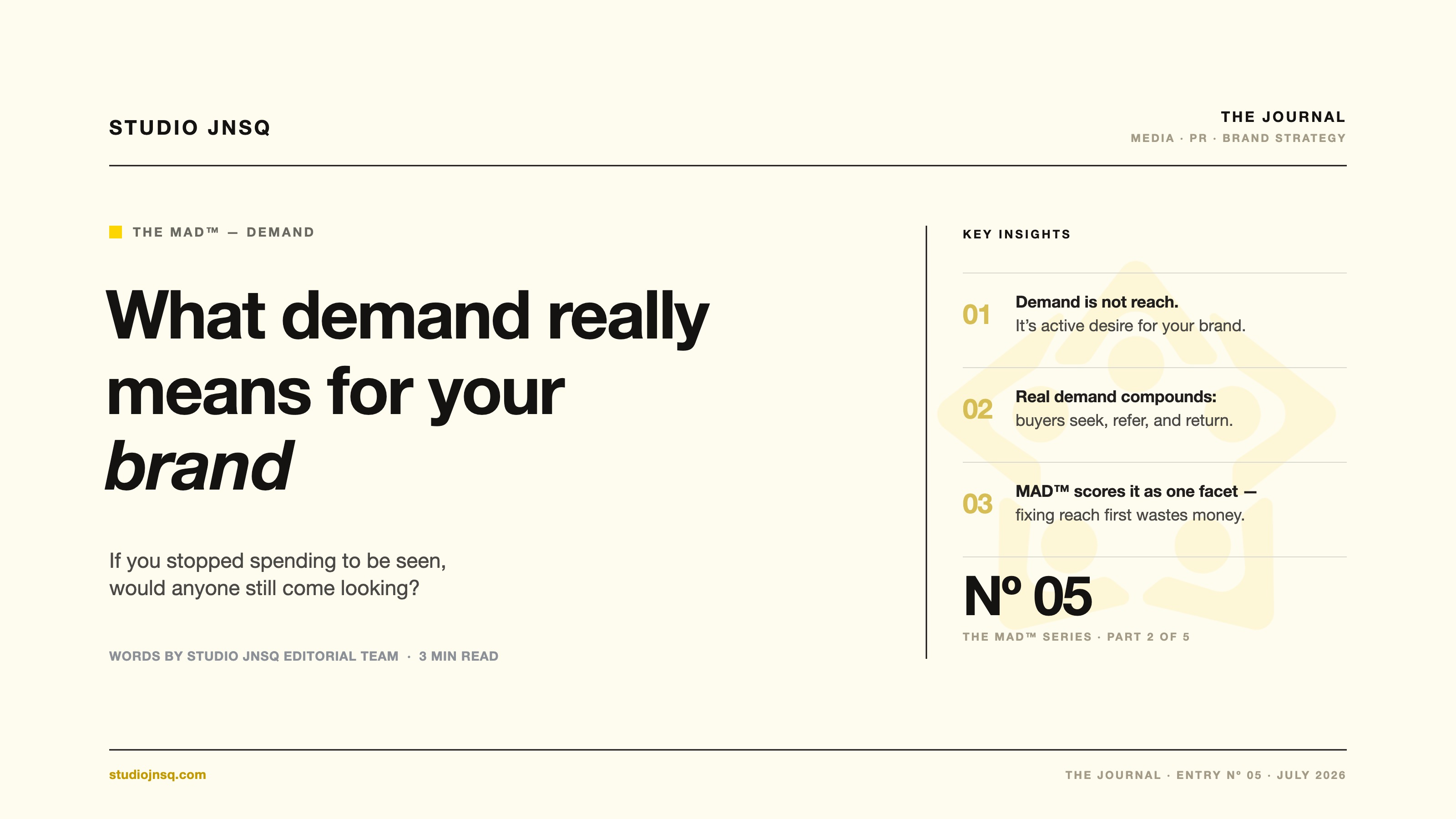
You are posting every day, running paid campaigns, doing outreach. But when you stop, the pipeline dries up immediately. That is not demand. That is reach on life support. The distinction matters more than most founders realize, because you can spend years optimizing a system that keeps you busy without building anything that lasts. Demand is what happens when the market wants you before you ask. It is the difference between a brand that runs and a brand that compounds.
What is demand and how is it different from visibility?
Visibility is how often you appear. Demand is how often people look for you specifically. You can have enormous visibility and almost no demand, which is exactly the situation most content-heavy brands find themselves in after two or three years of consistent posting without a corresponding rise in inbound or pricing power.
Visibility is an output of marketing. Demand is an output of brand equity. Marketing can create awareness, but it cannot manufacture desire. Desire comes from a combination of credibility, trust, consistent positioning, and a clear value signal in the market. Kantar BrandZ research shows that brands with high demand power capture 9x higher volume share, but only when the underlying brand dimensions are aligned. When those four things work together, people do not notice you; they want you.
The MAD™ diagnostic treats demand as its own distinct facet precisely because of this separation. You can score well on visibility and poorly on demand, and that tells us something very specific: the market sees you, but does not yet feel the pull toward you. That gap is fixable, but not with more content.
How do you know if your brand has real demand?
There are a few signals that indicate genuine demand rather than engineered reach. Inbound inquiries that come without a direct campaign attached. Referrals from people who heard about you through other people, not through your own channels. Prospects who mention your name specifically when they reach out, rather than saying they found a firm in your category.
The cleaner test is what happens when you go quiet. A brand with real demand continues to receive interest even during periods when it is not actively marketing. That interest was already running underneath, because the market has internalized a reason to want you.
If you pause everything tomorrow and the inquiry volume drops to zero within two weeks, the honest answer is that you have reach, not demand.
That is not a failure; it is a starting point. But calling it demand when it is not will keep you from building the real thing. Nielsen's research on long-term marketing confirms that ongoing brand investment accounts for 10–35% of a brand's total equity, and that a brand loses 2% in future revenue for every quarter it stops advertising. The brands that survive those pauses are the ones that built demand, not dependence.
What builds demand that compounds over time?
Demand builds from the same things that build brand equity at large: consistent positioning, genuine credibility signals, and compounding trust in the market. None of those happen through a single campaign or a content calendar.
Positioning is the clearest lever. When you stand for something specific, for a specific buyer, in a specific context, the market knows who to send to you. Generalist positioning produces polite interest; specific positioning produces desire. A firm known as the go-to for brand equity architecture in professional services will generate more demand than one that positions itself as a general strategy firm.
Credibility signals follow: case studies, press mentions, awards, client outcomes that are specific and verifiable. And then trust, which builds the slowest and compounds the most. Trust is what converts a buyer who has been watching you for six months into a buyer who reaches out ready to move forward. You cannot buy it, and you cannot rush it. What you can do is build the conditions for it, which is exactly what brand equity architecture is designed to do.
If your pipeline dries up the moment you stop spending, that is not a marketing efficiency problem. It is a demand problem. And demand problems live in brand equity, not in campaign optimization.
"Demand is not something you generate. It is something you earn. When the market wants you before you ask, every dollar you spend on visibility works harder because it is amplifying pull, not manufacturing it." — Jerico Lugo, Founder, Studio JNSQ
The MAD™ diagnostic treats demand as its own distinct facet precisely because of this separation. You can score well on visibility and poorly on demand, and that tells us something very specific: the market sees you, but does not yet feel the pull toward you. That gap is fixable, but not with more content.
— Jec