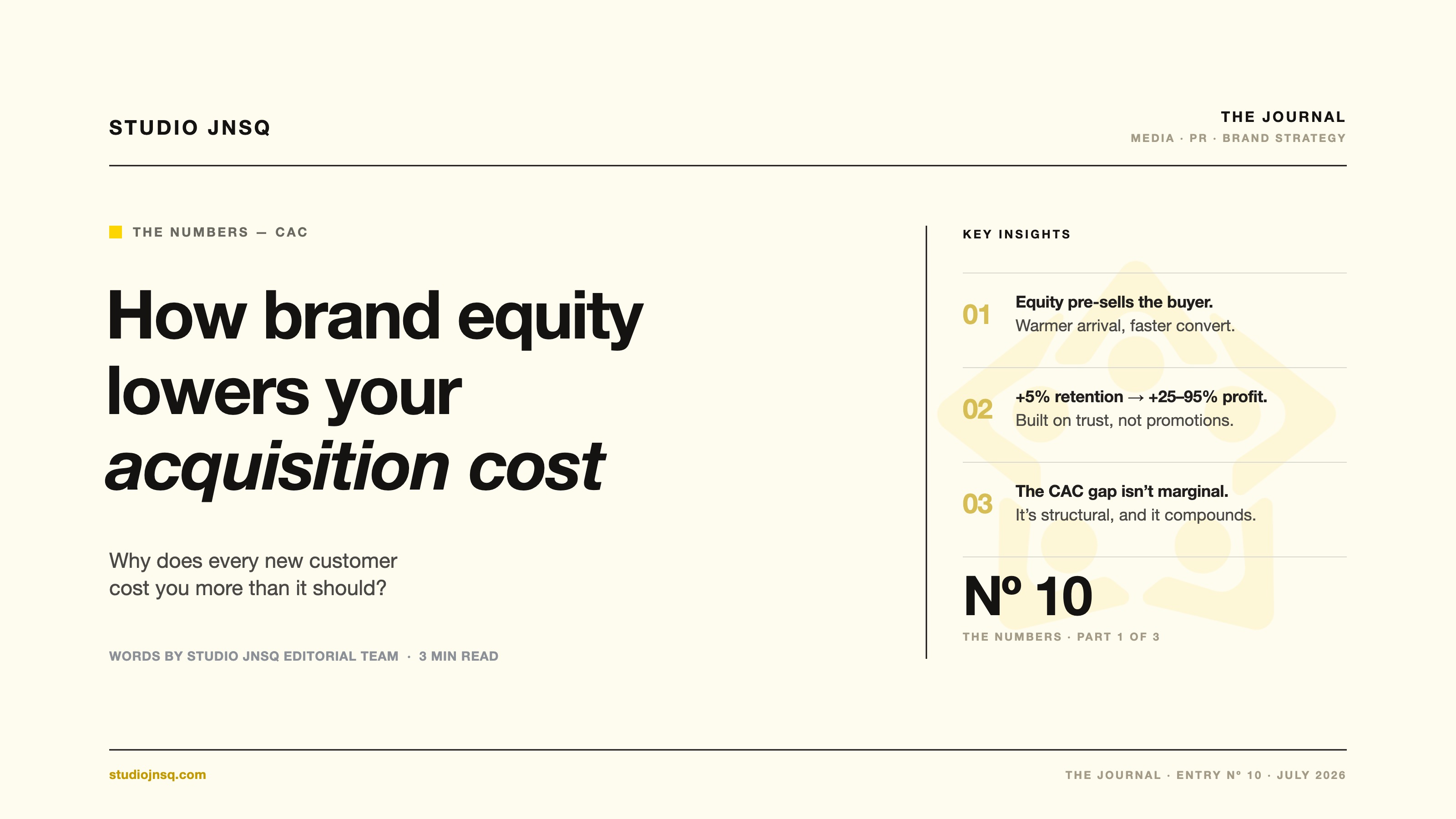
You are spending $400 to acquire a customer. Your competitor is spending $120. Your product is comparable, your offer is competitive, and your marketing is optimized. But their brand is doing pre-selling work that your ad budget has to do from scratch every single time. This is one of the clearest financial cases for brand equity architecture, and it gets overlooked because the mechanism is not obvious. You see the gap in CAC; you assume it is a marketing efficiency problem. You hire a better media buyer, refine the funnel, A/B test the landing page. The gap narrows slightly but never closes, because the root cause is not in the funnel. It is in the brand.
Why does brand equity lower CAC?
Every customer acquisition follows the same basic arc: awareness, consideration, trust, decision. Marketing drives awareness and keeps you in consideration. But trust is what converts consideration into a decision, and trust is not something a campaign can manufacture on demand. It is either there when the buyer arrives, or it is not.
When brand equity is strong, the market has already done the trust-building before the buyer encounters your funnel. They have seen your brand in contexts they trust: a publication they read, a peer who recommended you, a case study that felt relevant. By the time they click an ad or fill out a form, they are not starting from zero. They are starting from warm.
That warmth compresses the sales cycle, reduces the number of touchpoints required before conversion, and lowers the cost of each touchpoint. You are not fighting skepticism. You are confirming a decision the buyer was already inclined to make. Nielsen research on long-term marketing confirms the pattern: ongoing brand-building efforts account for 10–35% of a brand’s equity, and pulling back on that investment directly increases your cost of acquisition.
Same ad spend. Same funnel. Same sales team. Faster and cheaper conversion, because the brand already did the pre-work.
How much does brand equity reduce CAC?
The compounding effect is significant. Bain & Company’s research on customer retention shows that a 5% improvement in retention can increase profits between 25% and 95%. That retention is not driven by loyalty programs or re-engagement campaigns; it is driven by trust. Customers stay where they trust the brand to keep delivering on what it promised.
On the acquisition side, the gap shows up in three places:
Higher conversion rates from the same volume of leads, because trust is already established
Shorter sales cycles, because less time is spent building the case from scratch
Higher average deal sizes, because the value signal arrived before the sales conversation started
The compound effect is what makes the long-term financial case so strong: lower CAC produces higher margin, which funds better brand equity work, which lowers CAC further. The brands that build equity early get to operate at a structural cost advantage that widens over time. According to Kantar BrandZ data, the world’s strongest brands have outperformed the S&P 500 over two decades, growing faster in good times and proving more resilient during downturns.
The second move is positioning clarity. If a buyer cannot quickly understand why you specifically, the trust-building work takes longer because they are evaluating you alongside alternatives who are not meaningfully differentiated. A sharp, specific positioning statement that matches the language of your buyer’s problem cuts acquisition time significantly.
The MAD™ diagnostic is designed to show exactly which facet of your brand equity is suppressing your CAC efficiency. For some brands, it is a credibility gap. For others, it is a demand problem. Identifying the specific bottleneck is what allows you to invest in the right place rather than trying to fix everything at once.
"The brands that build equity early operate at a structural cost advantage that widens over time. Their competitors are still spending to overcome skepticism one campaign at a time." — Jerico Lugo, Founder, Studio JNSQ
Up next in The Numbers: Brand Equity and MRR, the compounding effect most founders miss. Part 2 drops on Thursday, July 31.
— Jec