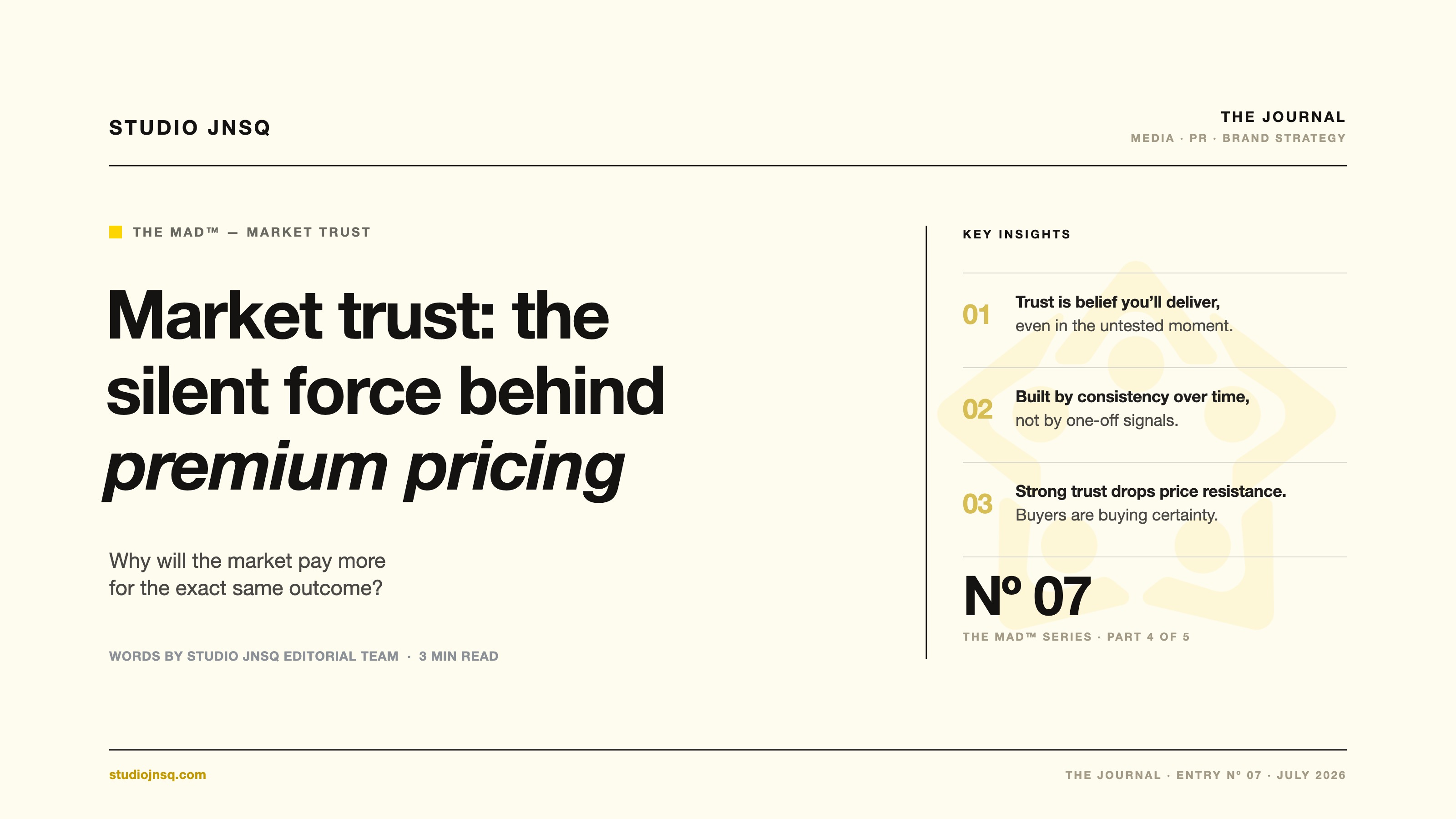
There are brands that get invited to pitch without ever submitting a proposal. They show up on shortlists they never applied for. Buyers recommend them before they have even been contacted. That is not luck or connections. That is market trust. Market trust is the quietest and most powerful facet of market authority, and it is the one that takes the longest to build and the shortest to damage. It is also the one that explains most of what looks inexplicable about premium pricing: why two providers with comparable offerings, comparable credibility, and comparable visibility can have wildly different close rates and price points.
What is market trust and how is it different from brand credibility?
Credibility is evidence-based: case studies, awards, press mentions, endorsements. It answers the question, "have they done this before, and do respected sources vouch for them?" Market trust goes deeper. It answers the question, "do I believe they will be who they say they are, in every situation, including the ones we have not been in together yet?"
You can have high credibility and low market trust if the signals you have built do not match the behavior you demonstrate. A brand with excellent case studies but that regularly shifts its positioning, changes its pricing without notice, or delivers inconsistently is building credibility while eroding trust. And the market notices, even when it cannot articulate exactly what feels off.
The Patek Philippe example is instructive. Their brand is not built on advertising campaigns or aggressive visibility. It is built on decades of consistent messaging, consistent quality, and a consistent understanding of who they are for. Deloitte's Future of Luxury research confirms this pattern: the next wave of luxury will treat trust as currency, and the brands that win will be those that translate operational discipline into brand story. That consistency has created a level of market trust that allows them to price in a category where almost no competitor can follow.
Why is market trust the hardest facet to build?
Because it cannot be engineered in a campaign or built on a timeline. Market trust is the cumulative output of every interaction a buyer or observer has had with your brand, directly or indirectly, over an extended period. Every time your positioning is consistent, it adds. Every time it shifts without clear reason, it subtracts. Every time you deliver exactly what you promised, it adds. Every time you overcommit and under-deliver, it subtracts.
The difficulty is that trust is asymmetric. It takes far longer to build than to lose, and the losses are often invisible until they show up in a buying decision you did not expect to lose. Deloitte's research on brand trust orthodoxies reinforces this: trust is not simply about doing the right thing; it is about consistently meeting expectations across every interaction, and the gap between brand promise and brand behavior is where trust erodes fastest.
Nothing is inherently bad or good in isolation. Market trust is earned through the long view.
Every brand decision is a compounding signal that either builds or subtracts from the accumulated perception the market holds of you.
What happens to a business when market trust is strong?
Price resistance drops. Buyer hesitation shortens. Referrals arrive without prompting. The sales cycle compresses because buyers are not using the sales process to evaluate your credibility; they have already done that. They arrived at the conversation already inclined toward yes.
More practically: when market trust is strong, your marketing budget works harder because you are not spending to overcome skepticism. You are spending to stay visible to buyers who are already warm. The work of conversion has been done before they ever reach out.
This is one of the clearest financial arguments for investing in brand equity architecture. Kantar BrandZ data shows that the world's most trusted brands outperform the S&P 500 by a significant margin over two decades. The brands with the strongest market trust are not closing more deals; they are closing them faster and at higher price points. That efficiency shows up directly in customer acquisition cost, in sales cycle length, and ultimately in the valuation a business can command.
Trust is not a soft metric. It is one of the most financially concrete assets a brand can hold. If your sales cycles are long and your close rates are inconsistent, the constraint may not be in your pitch. It may be in the trust signal your brand sends before the pitch begins.
"Trust compounds the way interest compounds. Every consistent signal adds to the principal. Every inconsistency withdraws from it. The brands that command premiums are the ones that have never stopped depositing." — Jerico Lugo, Founder, Studio JNSQ
If you want to measure where your brand stands across all four facets of the MAD™ framework, start with the MAD™ diagnostic. Or assess your commercial readiness with the RVF™ diagnostic.
— Jec