You are in a pitch. The buyer likes your proposal, likes your pricing, likes your team. Then they go with someone else because that someone else had three case studies, two awards, and a feature in a publication you have never heard of. That is credibility doing its work. It is one of the quieter forces in brand equity, which is part of why it is so chronically underinvested. Founders focus on visibility because it is measurable and immediate; you can see impressions, reach, and clicks. Credibility is harder to track and slower to build, so it tends to stay on the to-do list indefinitely, right up until the moment it costs you a deal you should have won.
What does credibility look like in practice?
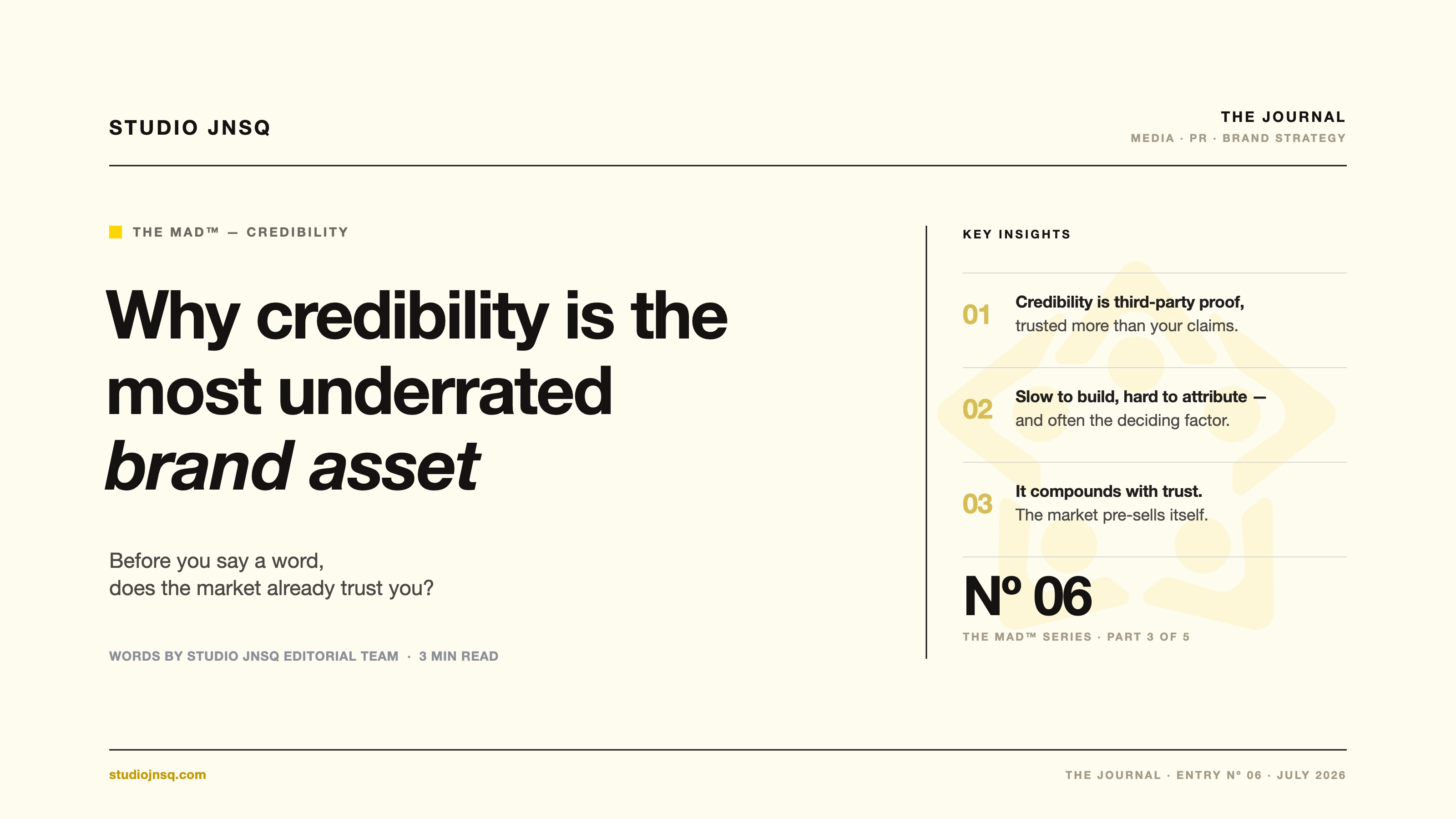
Credibility is third-party validation: signals the market receives about your brand from sources other than you. The most common forms are case studies with verifiable outcomes, industry awards and recognitions, features or mentions in publications your buyers read, endorsements from respected peers or partners, and credentials relevant to your field.
What makes credibility powerful is that it is information the buyer discovers rather than information you present. When a prospect searches your name before a meeting and finds a case study, a press mention, and an award, those three things do more persuasive work than anything you could say in the meeting itself. Kantar's research on trust validation confirms this: third-party validation serves as a shortcut to consumer trust, unlocking positive sentiment that self-promotion cannot replicate.
One client's experience illustrates this clearly: before we had done any direct outreach on his behalf, the PR and media architecture we built had positioned him so credibly in his space that the Canadian government reached out to him without any introduction. He had not applied for anything; they had found him through the credibility signals in the market and come to him. That is what credibility at scale looks like.
Why is credibility the facet most founders underinvest in?
Three reasons, and all of them are understandable.
First, credibility takes time. You cannot rush a case study; it requires a completed engagement with a willing client and a documented outcome. Awards require nominations and cycles. Press features require relationship-building with journalists or editorial teams. The payoff is real but delayed, which makes it easy to deprioritize in favor of activities with faster feedback loops.
Second, it is hard to attribute. When a deal closes, founders rarely know with certainty whether the press mention from six months ago was the deciding factor. So the attribution goes to the campaign that ran last week, and credibility-building stays unfunded. HBR's research on earning customer trust highlights this gap: more than 80% of consumers consider trust a deciding factor in purchase decisions, but only 34% trust the brands they use.
Third, most founders do not distinguish credibility from reputation. Reputation is what people generally think of you; it is diffuse and slow to form. Credibility is specific and verifiable; it is the evidence someone can point to when defending a purchase decision to their board. You can build credibility deliberately. Reputation tends to follow from it, not the other way around.
How do you build credibility when you are still early?
The first move is always documentation. If you have delivered results, write them down: the starting condition, the intervention, the outcome, and the timeframe. A well-documented case study from a single client is worth more than a year of social media content when it comes to credibility in a pitch room.
The second move is selective visibility in credible venues. Not all press is equal. A feature in a niche trade publication that your buyers read every week does more for your credibility than a mention in a mainstream outlet they never see. When you are early, targeted placement in the right venues compounds faster than broad coverage in the wrong ones.
The third move is peer association: being seen alongside, endorsed by, or in conversation with people your market already respects. This can happen through panels, collaborations, referrals, or joint content. Credibility borrows from proximity, and proximity to respected names transfers signal to your own brand faster than building from scratch alone.
Ask most business leaders what their biggest competitive advantage is and you will hear: our team, our process, our results, our experience. None of those matter if the market cannot verify them independently. Credibility is the bridge between what you know you are worth and what the market is willing to believe.
"Credibility is not about being impressive. It is about being verifiable. The market does not take your word for it. It takes the word of the sources it already trusts." — Jerico Lugo, Founder, Studio JNSQ
If you want to see where credibility sits in your Market Authority Diamond™ right now, run the MAD™ diagnostic. If you are building toward an exit or raising capital and need to understand how credibility drives valuation, the RVF™ diagnostic will map the path from signal to enterprise value.
— Jec