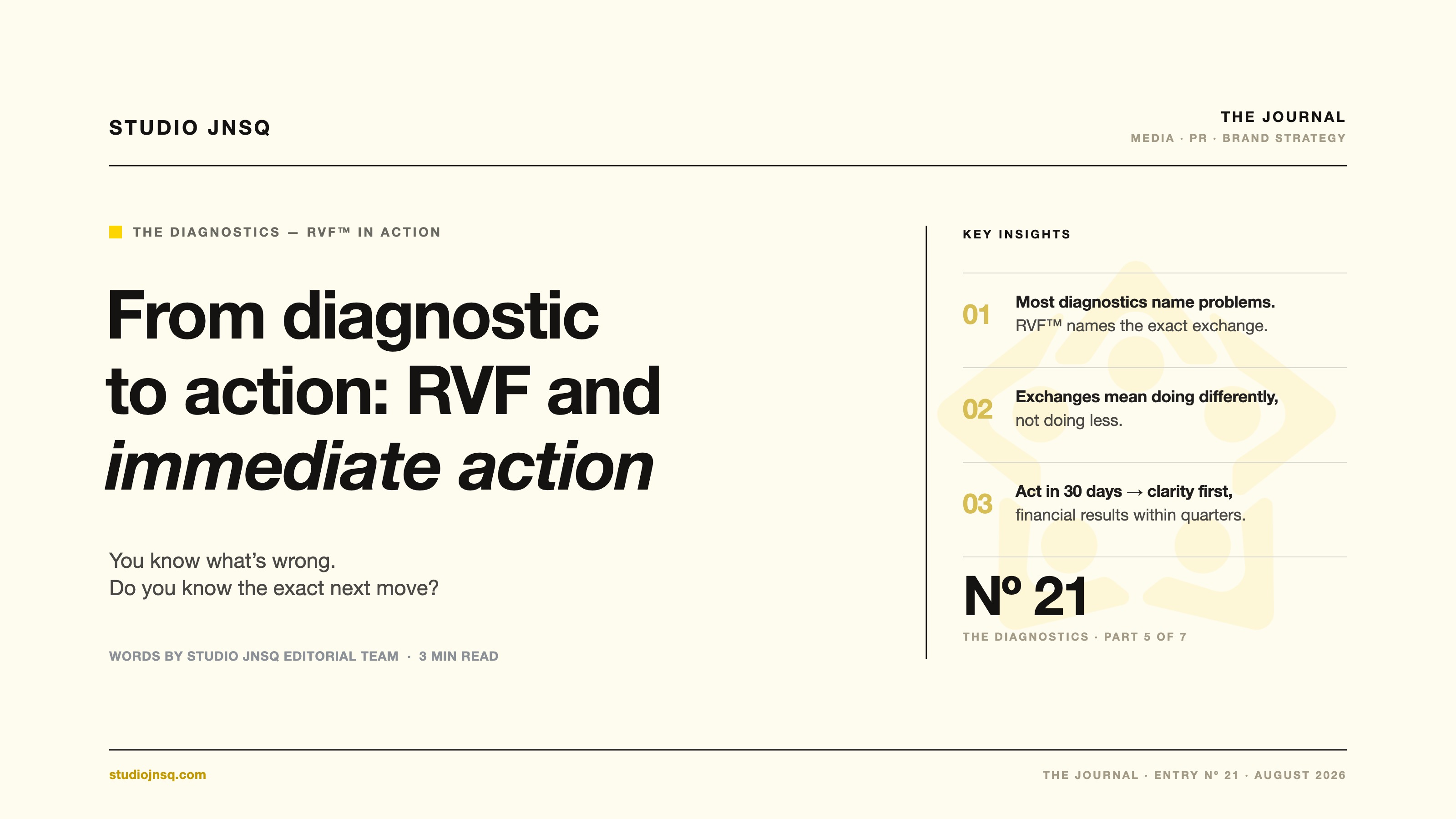
This is Part 5 of The Diagnostics. In Part 4, we covered what happens after your MAD™ diagnostic. Now: how the RVF™ creates immediate actionability from your scores.
Most diagnostics tell you what is wrong and leave you to figure out what to do about it. The RVF™ was designed differently. It does not score your resource allocation and walk away. It shows you exactly where the imbalance is and what exchanging one resource for another would change. This was a deliberate design decision. Brand equity architecture is a systems discipline, and systems thinking requires seeing not just the current state but the levers. The RVF™ is built around the principle that every resource allocation problem in a service business has a specific exchange that addresses it, and the job of the diagnostic is to make that exchange visible.
Why is actionability built into the RVF™?
For service business founders who are already stretched across delivery, business development, operations, and strategy, a mirror without a map is one more thing to feel bad about. McKinsey's research on resource reallocation found that companies with nimble resource reallocation are worth 40% more after fifteen years. The RVF™ applies that principle at the individual business level.
The RVF™ is built to be a map. Every imbalance it surfaces comes with a directional signal: here is the resource that is over-deployed, here is the one that is under-deployed, and here is what the exchange looks like in practical terms.
How do RVF™ resource exchanges work in practice?
A resource exchange is exactly what it sounds like: you reduce deployment of one resource and increase deployment of another, with the goal of improving the value you generate from the total.
Some exchanges are structural: you are spending forty hours a week on client delivery that could be handled by a well-briefed hire, freeing your Time for the business development that compounds the brand. The exchange is Money (hiring cost) for Time (your strategic capacity).
Other exchanges are pricing-related: you are deploying significant Effort into work you have been underpricing, which means the value equation is broken at the source. The exchange is raising the Money return on that Effort, either through repricing or repackaging. Harvard Business Review's research on lifetime value makes a parallel point: most companies undervalue the relationships they have already built.
Still others are operational: you are deploying Money into tools, subscriptions, or contractors that are not generating proportional value, and that Money could be redeployed into activities with higher leverage. The diagnostic makes these leaks visible.
Systems, once set up, run. The RVF™ helps you set up a resource system that runs efficiently.
What does acting on RVF™ results look like?
The first thing that typically happens is operational clarity. Founders who have been context-switching across too many priorities suddenly have a framework for saying no. If an activity does not align with the resource exchange the diagnostic identified, it goes on hold.
In the first thirty days, this usually shows up as a to-do list that gets shorter rather than longer. Decisions that were previously difficult, whether to hire, whether to raise prices, whether to cut a service line, become straightforward because the RVF™ results have already answered the underlying resource question.
In the first quarter, the financial effects begin appearing: slightly higher margins from better pricing, slightly lower delivery burden from better delegation, slightly stronger pipeline from more strategic time allocation. Kantar BrandZ data confirms the pattern at scale: brands that align their resource deployment with equity-building activities consistently outperform those that do not.
If you have taken the RVF™ diagnostic, start with your primary imbalance. Do not try to fix everything at once. Sequential improvement is more durable than simultaneous overhaul.
"A diagnostic that ends at the score is a mirror. A diagnostic that shows you the exchange is a compass. The RVF™ was built to be a compass." — Jerico Lugo, Founder, Studio JNSQ
Up next in The Diagnostics: RVF™ and Clarity: How the Right Diagnostic Cuts Through Decision Paralysis. Part 6 drops on Sunday, August 23.