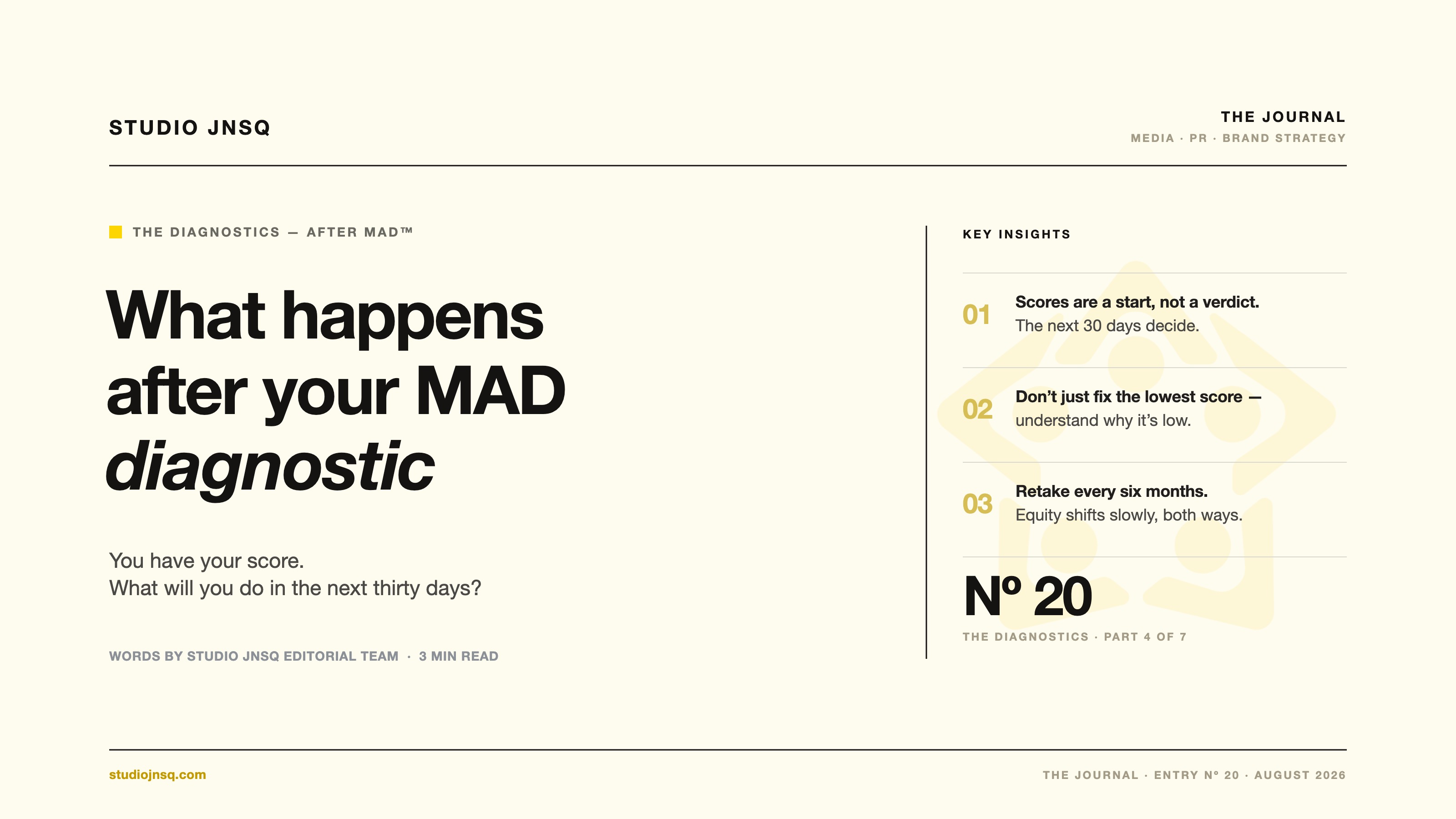
This is Part 4 of The Diagnostics. We have covered both frameworks and the RVF™ for service businesses. Now: what happens after you take the MAD™ diagnostic, and what to do with your scores.
You have your MAD™ scores. You know where your brand is strong and where it is leaking. Now what? The diagnostic is the starting point, not the destination. What happens next determines whether those numbers turn into brand equity. This is the part most founders underestimate. Taking a diagnostic and understanding your scores is useful; it is a clear-eyed picture of where your brand stands. But brand equity architecture is not about knowing; it is about building. The report gives you the map. You still have to do the work.
What are the immediate next steps after getting your MAD™ results?
The first thing to do is sit with them before you act on them. Not for long, a day or two at most, but enough to let the picture settle. The initial reaction most founders have is to jump to fixing the lowest score. That is understandable, but it is not always right. Sometimes a low score in one facet is a symptom of a structural issue in another.
After that settling period, identify what we call your constraint facet: the one weakness that, if addressed, would have the highest leverage effect on the others. This is not always your lowest score. McKinsey's research on brand-driven growth reinforces this: the brands that outperform financially are not the ones that improved everything equally, but the ones that identified and addressed their highest-leverage constraint first.
A brand with low Visibility but strong Credibility, Demand, and Market Trust has a reach problem. A brand with low Market Trust but strong Visibility has a much more urgent and fundamental problem, because every new person who discovers the brand is discovering a brand they are not ready to trust.
How do you build a roadmap from your diagnostic scores?
A roadmap from MAD™ results is not a generic marketing plan. It is a sequence of moves designed to strengthen the specific facets holding your brand equity back, in an order that makes sense given where you are right now.
The underlying logic is always the same:
Stabilize Market Trust first, because it is the foundation.
Build Credibility signals if they are weak, because credibility enables the conversion of attention into trust.
Expand Visibility, because visibility backed by credibility compounds; visibility without it creates noise.
Branding and Demand tend to respond to the other three. When trust, credibility, and reach are working together, demand follows. Kantar BrandZ data shows the strongest brands have delivered 88% higher returns than the S&P 500 over twenty years, and the common factor is structural coherence across these dimensions, not spending more on any single one.
When should you retake the diagnostic?
Six months is the right interval for most brands. Longer than a quarter because brand equity moves slowly, shorter than a year because you want to catch problems before they compound in the wrong direction.
There are also trigger events worth retaking for: a significant repositioning, a pricing change, a major media moment, or a shift in your target market. Kevin Keller's Brand Report Card emphasizes that the strongest brands track their equity systematically over time; the MAD™ gives you that tracking mechanism.
The retake is where the diagnostic becomes a longitudinal tool rather than a snapshot. Over two or three cycles, you start to see the real shape of your brand equity trajectory.
If you have taken the MAD™ diagnostic, your next step is clear: identify your constraint facet, build a sequenced plan, and begin. If you have not taken it yet, start there. The diagnostic is free, it takes five minutes, and it gives you the baseline that makes everything else strategic rather than reactive.
"Scores without action are trivia. The diagnostic gives you the map. The roadmap gives you the route. The work is what builds the equity. Do not confuse measurement with progress." — Jerico Lugo, Founder, Studio JNSQ
Up next in The Diagnostics: From Diagnostic to Action: How the RVF™ Creates Immediate Actionability. Part 5 drops on Friday, August 21.