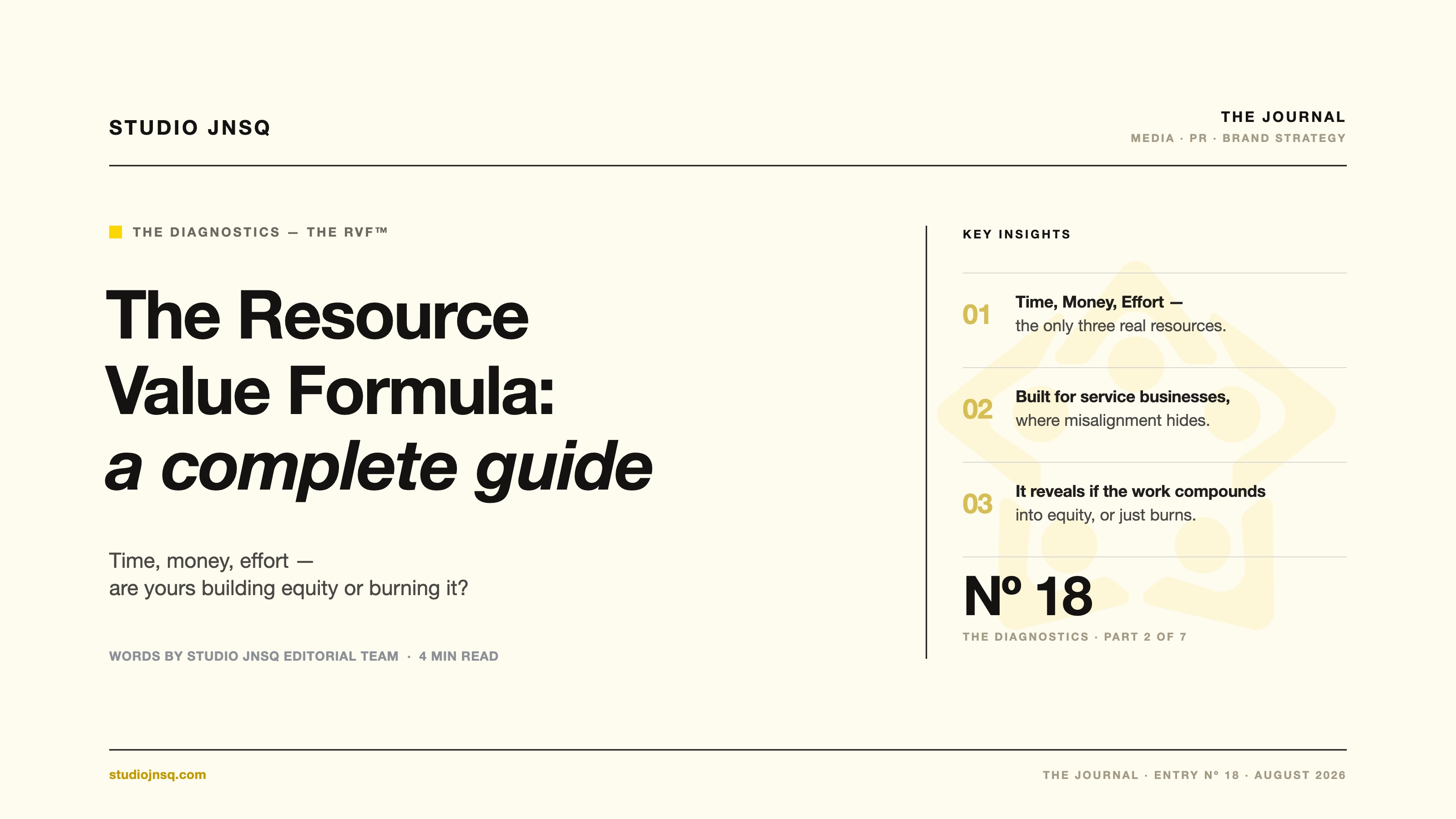
This is Part 2 of The Diagnostics. In Part 1, we introduced the Market Authority Diamond™. Now: the Resource Value Formula™, and the three trades every business moves through.
You are putting in the hours, spending the money, burning through effort, and the results are there on paper. But something feels off. The growth is not compounding the way it should. The RVF™ was built for exactly this moment: when the inputs look right but the outputs are not building toward long-term value. Most business diagnostics measure outputs: revenue, pipeline, leads, conversion rate, margin. Those are useful numbers. But they do not tell you whether the inputs that generated them are sustainable, scalable, or aligned with the kind of brand equity that makes a business valuable over time. The RVF™ starts from the inputs and works forward, asking a different question: how are you deploying your three core resources, and is that deployment building toward durable value?
What is the Resource Value Formula™ and who needs it?
The RVF™ is a diagnostic tool for service-based businesses. It measures how Time, Money, and Effort are being allocated across the business and scores how well that allocation is aligned with brand equity creation. McKinsey’s research on resource allocation found that companies with nimble resource reallocation are worth an average of 40% more after fifteen years. The RVF™ applies that principle at the service-business level, where the resources are personal, not corporate.
It is built specifically for service businesses because service businesses have a structural resource challenge that product businesses do not. In a product business, the resource investment is largely separable from the founder. In a service business, the founder’s time, effort, and judgment are often the product. That makes resource alignment much harder to see and much more critical to get right.
Why Time, Money, and Effort and not traditional business metrics?
Because Time, Money, and Effort are the only three resources that exist in a business. Every other input is a derivative: human capital is time and effort; marketing spend is money; operational capacity is time and effort; technology investment is money. When you strip any resource question back to first principles, it resolves into one or more of these three. That is not a simplification; it is the actual structure of how a business deploys its capacity.
Traditional business metrics measure what those resources produced. A business can produce strong outputs in the short term from a resource allocation that is fundamentally misaligned with long-term value creation. A founder who is personally delivering every high-value client engagement is generating revenue, but they are also creating a resource constraint that will prevent scaling and a dependency that will reduce the business’s equity value. The RVF™ surfaces that misalignment before the revenue numbers reveal it.
The multi-disciplinary insight behind the framework is that resource allocation is not just an operational question; it is a brand equity question. Where you spend your time sends a signal to the market about what you value. Where you invest money shapes what the market can see of your brand. Harvard Business Review’s research on customer lifetime value reinforces this: the most valuable customer relationships are built through deliberate resource investment, not reactive spending.
When crushed with lack of resources, think in exchanges. Find equitable compromises.
What does your RVF™ score reveal?
The RVF™ produces scores across four aspects of resource alignment and an overall resource value score. The aspect scores reveal where each resource is being deployed most productively, where misalignment is highest, and which reallocations would have the greatest impact on brand equity creation.
Remember, it is not always about doing all things at once from the start, but building pieces and putting them together. The RVF™ score helps you see which pieces are already in place, which are missing, and in what order to build the missing ones. A business that is heavily time-constrained needs a different strategy than one that is capital-constrained or effort-diffused.
The most revealing output is often the misalignment pattern: the gap between where resources are going and where brand equity requires them to go. A service business spending 70% of its effort on client delivery and 5% on market presence has a resource allocation that sustains existing revenue but does not build the market authority that creates future demand.
If you run a service business, start with the RVF™ diagnostic. It takes fifteen to twenty minutes and shows you exactly where your three resources are aligned and where they are leaking.
"Resource alignment is not an efficiency question. It is a brand equity question. Where your time, money, and effort go determines what the market sees, what it trusts, and what it values." — Jerico Lugo, Founder, Studio JNSQ
Up next in The Diagnostics: Introducing the RVF™ Diagnostic for Service-Based Businesses. Part 3 drops on Sunday, August 16.