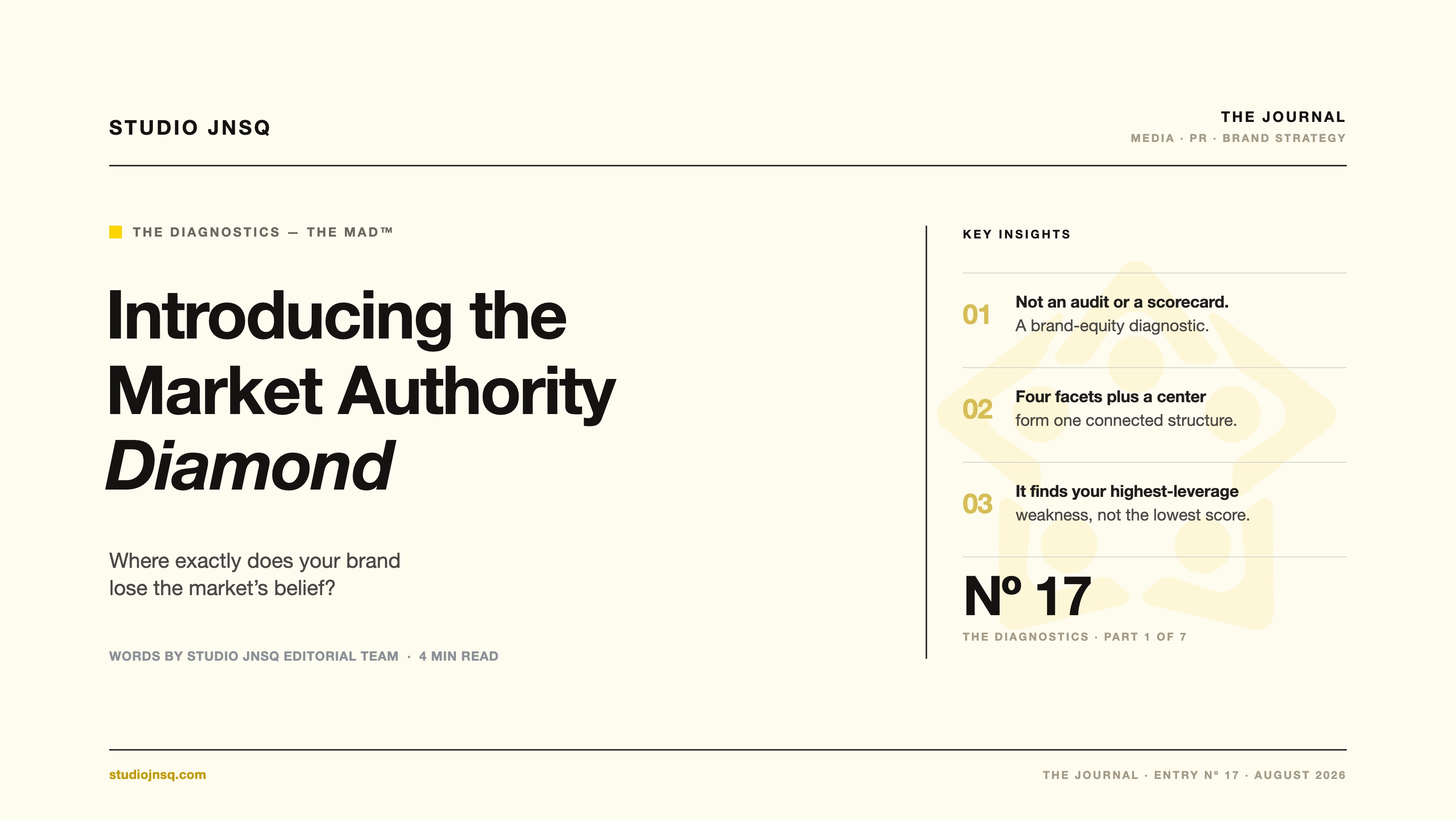
This is the first installment of The Diagnostics, a seven-part series. Over the coming editions, we walk through the MAD™ and RVF™ diagnostic tools: what they measure, how to read them, what to do after, and how they work together.
You have been told your brand needs more visibility, or stronger positioning, or better content. But nobody has told you which of those things matters most for your specific situation, because nobody measured it. The Market Authority Diamond™ was built to change that. Market authority is not the same as brand awareness. It is not a measure of how many people have heard of you. It is a measure of the structural strength of your brand's position in the market: how much trust it holds, how much demand it generates, how credible it is, and how consistently it shows up. Kantar's brand equity research confirms that brands with the strongest equity consistently outperform on financial metrics, but only when the equity is structural rather than superficial.
What is the Market Authority Diamond™ and why does the MAD™ framework exist?
The MAD™ exists because most brand diagnostics measure the wrong things. They measure aesthetic consistency, social media presence, or campaign performance, all of which are outputs of brand activity, not measures of brand equity. What the MAD™ measures is the underlying architecture: the four facets and the centering point that determine whether a brand's activity is building equity or generating noise.
It exists because brand equity can be measured, not perfectly, but with enough precision to be useful for strategic decisions. Interbrand's Best Global Brands methodology evaluates brand strength across ten factors including internal commitment, market responsiveness, and relevance. The MAD™ applies a parallel principle to businesses at every stage: codifying the patterns that separate brands with genuine market authority from those with surface-level activity.
How do the four MAD™ facets and Branding as centering point work together?
Demand sits at the peak of the diamond. It is the most direct expression of market authority: the degree to which the market actively seeks out your brand, rather than you having to push it toward them. Strong demand is the result of all the other facets working well. Weak demand, despite active marketing, usually signals structural gaps in one or more of the other facets.
Market Trust forms the foundation. It is the cumulative result of the brand's consistent performance over time: the reputation, the word-of-mouth, the referral behavior, the general sentiment in the professional ecosystem. Without a strong foundation of trust, the other facets build on unstable ground.
Credibility and Visibility form the walls. Credibility is the brand's ability to demonstrate expertise and authority to people who do not already know it. Visibility is the brand's presence in the channels and contexts where its target market is actively making decisions. A brand with high credibility and low visibility is being trusted by people who cannot find it. A brand with high visibility and low credibility is being seen by people who do not believe it.
Branding sits at the center. It is the connecting layer that ties all the other facets together: the visual and verbal identity, the positioning clarity, and the consistency of the brand experience across every touchpoint. Branding at the center does not mean it is the most important facet; it means it is what makes the other facets coherent.
The diamond is a structure, not a checklist. The facets reinforce or undermine each other.
What does your MAD™ score tell you?
Your MAD™ score produces a rating for each facet and an overall market authority score. But the diagnostic is more useful than the scores alone. What matters most is the pattern: which facets are misaligned, which gaps are creating structural weaknesses, and which investments will have the highest leverage. Kevin Keller's Brand Report Card in Harvard Business Review identified ten characteristics the strongest brands share; the MAD™ translates that principle into a measurable diagnostic for businesses at any stage.
A brand with strong Credibility and weak Visibility has a different strategic problem than a brand with strong Visibility and weak Market Trust, even if their overall scores are similar. The MAD™ makes that distinction visible.
The score also serves as a baseline for tracking progress over time. Brand equity builds slowly and compounds over months and years. Without a baseline, it is difficult to know whether the work you are doing is moving the architecture or creating activity. With a MAD™ baseline and a follow-up diagnostic at six months, you can see exactly which facets moved and what that movement means for your overall market authority position.
If you want to find out where you stand, start with the MAD™ diagnostic. It takes five minutes and it gives you the market authority picture that makes everything else make sense.
"Brand equity is structural, not cosmetic. The diamond gives you the architecture so you can see which walls are holding and which ones need reinforcement before you invest in reach you cannot convert." — Jerico Lugo, Founder, Studio JNSQ
Up next in The Diagnostics: The Resource Value Formula™ Complete Guide. Part 2 drops on Friday, August 14.