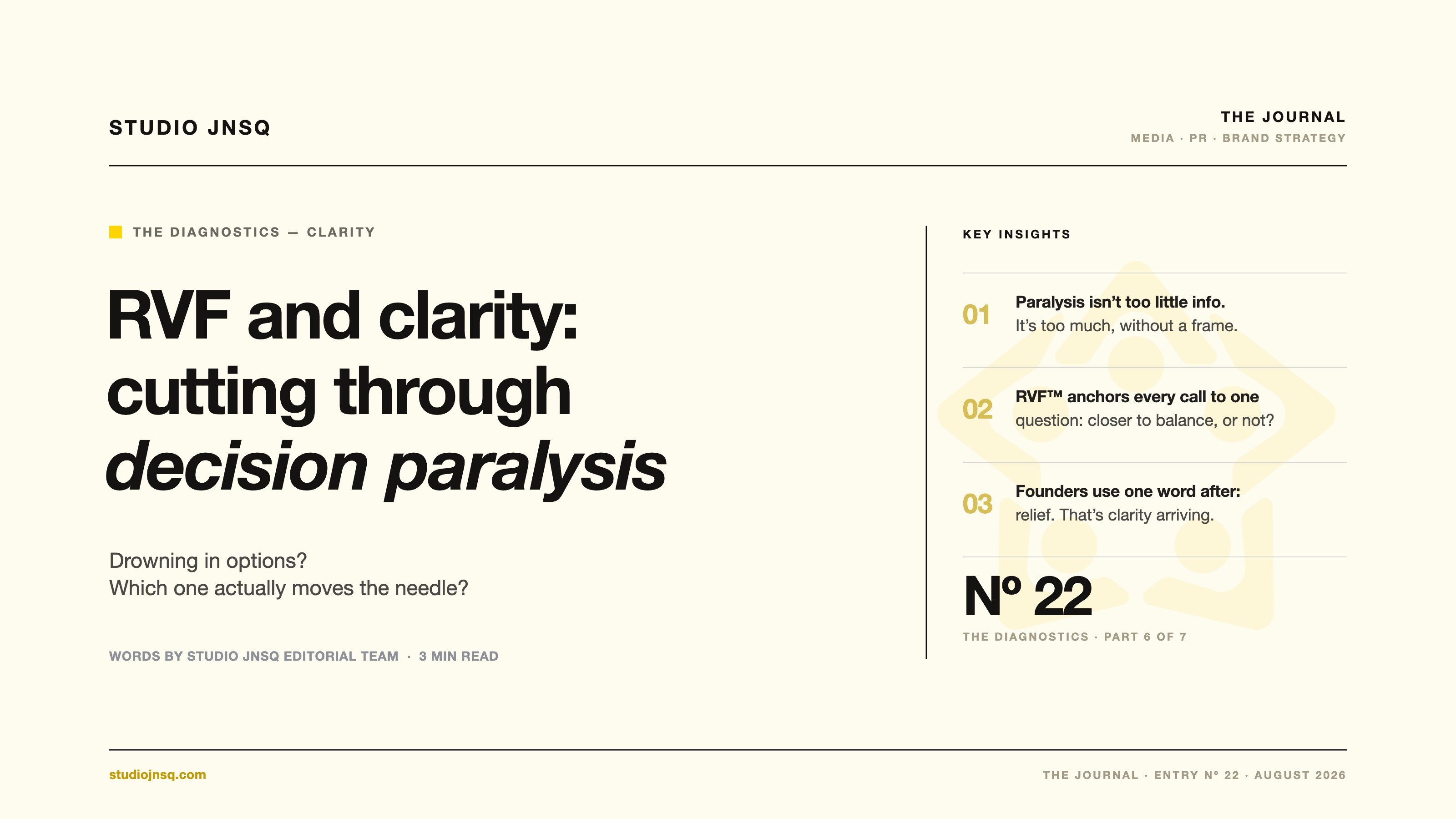
This is Part 6 of The Diagnostics. We have covered both diagnostic tools and their post-diagnostic paths. Now: how the RVF™ cuts through decision paralysis when you do not know where to start.
You have twelve priorities, seven consultants giving you conflicting advice, and a strategy deck from last quarter that nobody is following. The paralysis is not from lack of information; it is from too much of it without a framework to filter through. Decision paralysis in growing service businesses is almost always an information problem, but not in the way founders expect. The instinct is to gather more data: more analytics, more competitor research, more customer interviews. The real problem is not the volume of data but the absence of a framework for filtering it. McKinsey's research on resource allocation found the same dynamic at the corporate level: 83% of executives identify resource reallocation as the top growth lever, yet most lack the diagnostic framework to execute it.
Why do business owners get paralyzed by growth decisions?
Options multiply faster than clarity. A solo consultant in year two has relatively few real options: serve clients, develop skills, build reputation, generate pipeline. By year five, that same consultant has accumulated relationships, service lines, pricing tiers, potential partnerships, platform decisions, and team considerations, each with its own advocates and its own logic.
The human mind is not built to hold twelve competing priorities and evaluate them simultaneously. What it does instead is prioritize the loudest, the most recent, or the most emotionally resonant, which is why founders often find themselves chasing the last conversation they had rather than executing the strategy they agreed on a month ago.
The result is not inaction; most founders are extremely busy. It is misdirected action: effort that does not compound, Time spent on things that feel urgent but are not strategic, Money deployed into solutions for problems that are symptoms rather than causes.
How does the RVF™ cut through decision noise?
The RVF™ cuts through by doing something simple but powerful: it reduces every option to a resource question. Before you evaluate any strategic decision, you ask what resource it primarily requires, Time, Money, or Effort, and whether your current allocation has room for that resource deployment.
This is not a constraint; it is a filter. When you know that your Time is over-deployed and your Money is under-deployed, the decision between hiring and doing something yourself is no longer a strategic debate. It is an arithmetic answer. Kantar BrandZ data shows the same principle at scale: the brands that outperform are not the ones making the most decisions, but the ones making the right ones with resource clarity.
We need first to check where you are, not where you were, not where you want to be, but where you are presently.
What does clarity feel like after taking the RVF™?
Founders who go through the RVF™ and act on their results consistently describe a similar experience. The first feeling is not excitement or urgency but something closer to relief. The relief of having a framework that makes certain decisions easy, of being able to say no to things without guilt because the diagnostic has shown you why that no is correct.
After the relief comes focus. With a clear picture of which resource is the constraint, the to-do list reorganizes itself. Things that do not address the constraint move to the back. Things that do, even if they are difficult or unfamiliar, move to the front.
The clarity is not permanent; resource allocation drifts as businesses grow and as external conditions change. But the diagnostic gives you the skill of reading your own resource picture, which means you can recalibrate faster the next time the noise builds up. Harvard Business Review's research on brand management reinforces the same principle: systematic measurement creates the clarity that intuition alone cannot sustain.
If you are stuck in decision paralysis, start with the RVF™ diagnostic. It will not add to the noise. It will give you the filter to cut through it.
"Clarity is not knowing everything. It is knowing which resource question to answer first. When that question is clear, the rest of the decisions fall into sequence." — Jerico Lugo, Founder, Studio JNSQ
Up next in The Diagnostics: The Full Picture: Using MAD™ and RVF™ Together to Drive Brand Equity and Revenue. Final installment drops on Wednesday, August 26.