Last edition, we walked through the brand equity audit checklist and the blind spots most founders do not see until they are mapped out. This one picks up where that leaves off: once you have your MAD™ scores, how do you read them, and what do you do first?
You took the MAD™ diagnostic and you are looking at your scores. Four facets and the centering point, each with a number. Some are strong, some are weak, and you are not sure what to do with any of it. Here is how I read a MAD™ report and what I look for first. The most common mistake I see is treating the report like a to-do list: lowest score gets attention first, highest score gets ignored. That is not how it works. Brand equity is a system, and the four facets and the centering point interact. Reading the report well means reading it as a pattern, not as individual numbers.
What do the scores across Branding and the four facets mean?
Demand is the pull. It measures whether the market actively seeks you out or whether you are always chasing. Credibility is your standing: what the market believes about your expertise and track record. Visibility is reach, specifically whether the right people can find you. Branding is coherence: whether your identity reinforces or contradicts the position you are trying to hold. Market Trust is the deepest layer: the degree to which the market believes you will deliver consistently over time.
A high score in any one of these is valuable. But the facets reinforce each other, and a collapse in one can undermine the others. Kantar BrandZ research confirms this pattern at scale: brands with structural coherence across equity dimensions outperform those with isolated strengths. High Visibility with low Credibility often makes things worse. High Demand with low Market Trust is a short-term pipeline that does not compound.
Which MAD™ facet should you focus on first?
I always look at Market Trust first, regardless of its score. Market Trust is the foundation the other four sit on. If it is strong, a weakness in Visibility or Branding is a growth problem, solvable with resources and strategy. If Market Trust is weak, a strength in Demand or Credibility will eventually erode.
After Market Trust, I look at the relationship between Demand and Credibility. If Demand is low but Credibility is high, the brand has earned its position but has not communicated it widely enough. That is a very different problem than high Demand with low Credibility, which usually means the brand is growing faster than its substance can support.
As I observe with every founder who goes through this: we need first to check where you are, not where you were, not where you want to be, but where you are presently. The report is a present-tense document.
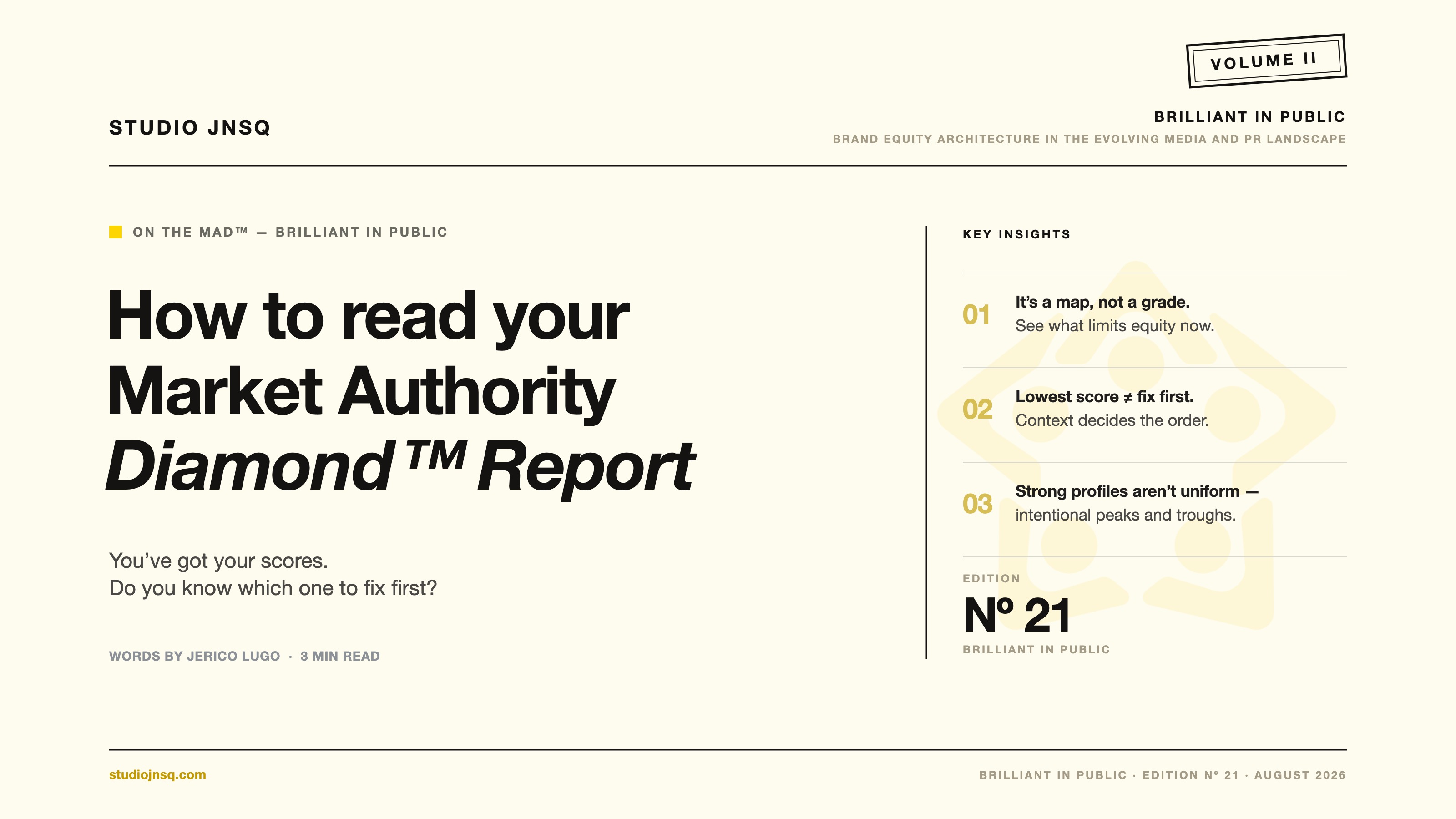
Read the report as a pattern, not a to-do list. The interactions matter more than the individual scores.
What does a strong MAD™ profile look like versus a weak one?
A strong profile is not a five-out-of-five across every facet. What I look for is intentional asymmetry: a brand that has built genuine authority in two or three facets, has a clear path on one or two more, and has an honest assessment of where it is not competing. Interbrand's brand strength methodology evaluates brands the same way: not by uniformity, but by the coherence and intentionality of their strengths.
The weakest profiles I have seen are the ones where every score hovers in the middle. That is a brand that has not committed to being excellent at anything. The market does not reward average across the board; it rewards being distinctly strong in the dimensions that matter for your specific position.
Your MAD™ report is the starting point for knowing which dimensions are yours to own. Once you know that, the roadmap follows naturally. Kevin Keller's Brand Report Card makes the same observation: the strongest brands are not strong everywhere; they are strategically strong where it counts.
If you have taken the MAD™ diagnostic, pull up your report. Look at the pattern, not the individual numbers. Find your constraint facet. Build from there.
"The strongest brands do not chase uniform scores. They build intentional peaks in the facets that drive their market position, and they let the compounding do the rest." — Jerico Lugo, Founder, Studio JNSQ
If you have taken the MAD™ diagnostic, pull up your report. Look at the pattern, not the individual numbers. Find your constraint facet. Build from there.
Trace backwards through the diamond.
If you have already taken the MAD™ diagnostic, look at your lowest-scoring facet. Now ask: is this facet low because of neglect, or because another facet is dragging it down? Low Demand is almost never a demand problem; it is usually a symptom of weak Credibility or Visibility upstream. Trace backwards through the diamond. The root cause is usually one or two steps removed from the symptom.
— Jerico Lugo, MCIPR