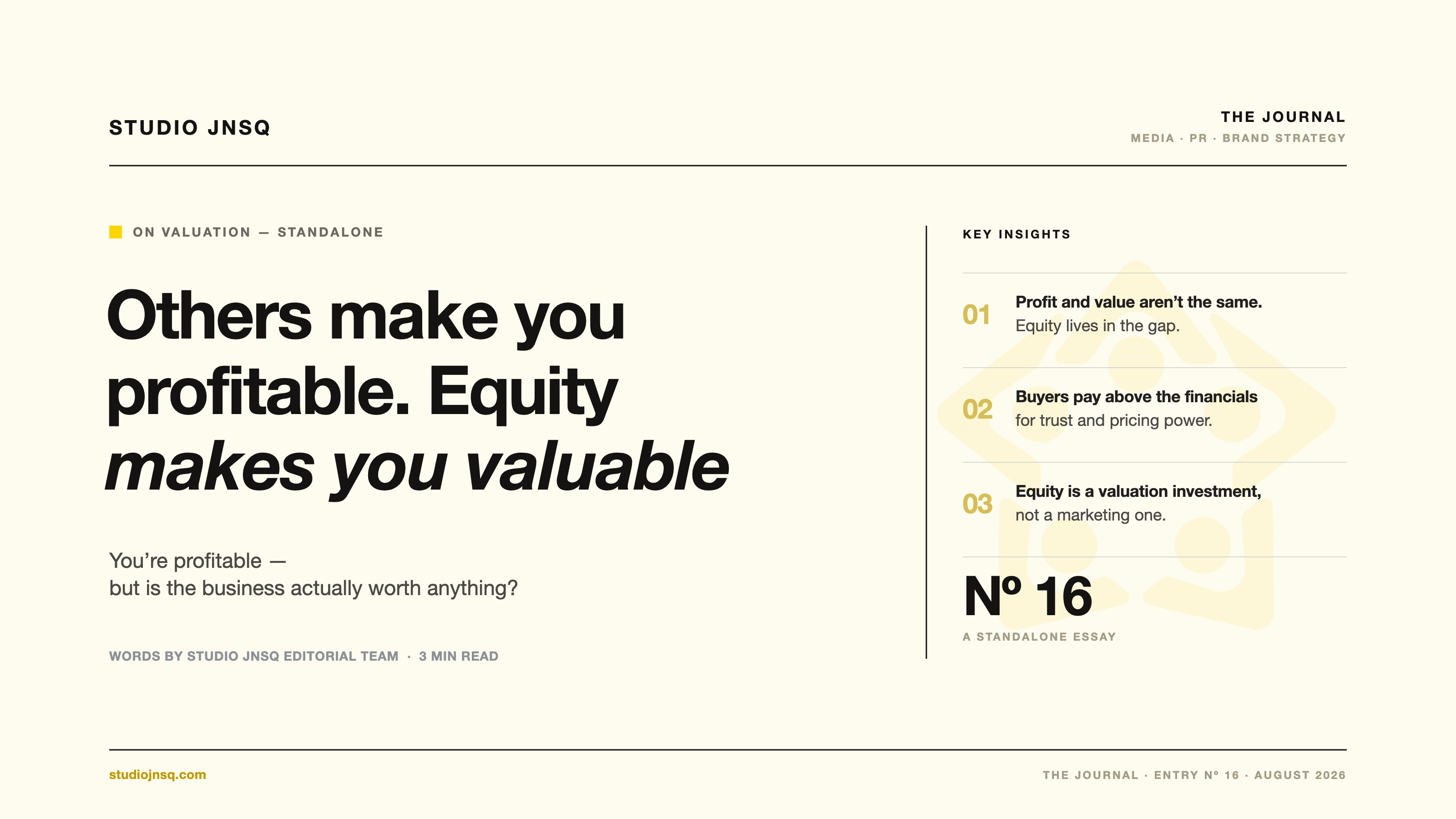
We just wrapped The Practice, and before we move into The Diagnostics, this one stands on its own. Your accountant can tell you what your business earned. Your financial advisor can tell you what your assets are worth. But neither of them can tell you what your brand is worth, because brand equity lives in a space that most financial frameworks do not account for.
This is the distinction that sits at the center of everything we do at Studio JNSQ. Marketing agencies make you profitable: they drive leads, conversions, and revenue. Financial advisors preserve and grow the value of what you have. But the architecture of brand equity, the discipline of building the financial and reputational value of a company, is where profitability converts into value. Others make you profitable. Brand equity makes you valuable.
What is the difference between profitability and value?
Profitability is a measure of what a business earns relative to what it costs to operate. A business is profitable when revenue exceeds expenses, and the margin between them is what most founders and operators focus on. It is the right thing to focus on for survival and short-term health. But profitability does not determine value.
Value is what a business is worth to a buyer, a partner, an investor, or a market. It is determined by what that business can generate in the future and how defensible that future is. Two businesses with identical profitability can have dramatically different values depending on the strength of their brand equity. According to Ocean Tomo’s Intangible Asset Market Value Study, intangible assets now constitute approximately 90% of S&P 500 market capitalization, a dramatic inversion from 1975 when tangible assets represented 83% of market value. Brand equity is the core of that intangible value.
The gap between those two businesses is brand equity. Poor financials would reflect in the packaging, products, and services most of the time, and your employee relations would also affect how the market perceives you. But beyond those operational signals, the structural value of a brand lives in its position in the market: how trusted it is, how recognized, how difficult to replicate. That is not visible in the income statement. It lives in the brand equity architecture.
Others make you profitable. Brand equity makes you valuable.
Why do acquirers pay premiums that profit margins cannot explain?
When companies are acquired at multiples that seem disconnected from their earnings, the premium is almost always explained by brand equity. Interbrand’s research on brand valuation confirms that strong brands influence customer choice, create loyalty, attract and retain talent, and lower the cost of financing. The acquirer is paying not just for the current revenue stream but for the market position that the brand has built.
Consider what a strong brand delivers in an acquisition context:
Lower customer acquisition cost because the brand already has market trust.
Extended customer lifetime value because the brand already has retention equity.
Pricing power because the brand already has positioning that justifies a premium.
Reduced competitive risk because the brand already has a defensible position in its market.
None of those are in the income statement. All of them affect what the business is worth. The difference between a 1.5x multiple and a 4x multiple is transferable value: equity that lives in the brand, not in the founder or the sales team.
How do you build brand equity that outlasts quarterly performance?
The first step is treating brand equity as a strategic asset, not a marketing output. Kantar BrandZ data shows that brands with high equity have delivered 88% higher returns than the S&P 500 over two decades, proving that brand equity is not a marketing concept but a financial instrument. This means making decisions about positioning, identity, and market presence through a valuation lens rather than a campaign lens.
The second step is running a diagnostic against your current brand equity architecture. The MAD™ diagnostic maps the four facets and the centering point of market authority, Demand, Credibility, Visibility, and Market Trust, with Branding as the centering point, and scores where your brand currently stands in each. That score tells you not just where you are weak, but where investment will do the most to build long-term value.
The third step is building consistently and structurally. Brand equity is not built in campaigns; it is built in architecture. The positioning you own, the trust you accumulate, the market authority you establish: these compound over time, and the compounding is what creates the gap between your profitability and your value.
If you are a smaller company, brand equity architecture gets you to profitability with structure, direction, and a way to build market value without burning through cash on campaigns that expire. If you are a larger company, it builds a stronger case for a higher valuation on exit. Either way, the question is the same: is your business building equity that compounds, or generating revenue that resets?
"Profitability tells you the business is working. Value tells you the brand is working. When the architecture is right, every unit of revenue carries equity with it, and the gap between what you earn and what you are worth widens in your favor." — Jerico Lugo, Founder, Studio JNSQ
Next up, we begin The Diagnostics, a seven-part series on the MAD™ and RVF™ diagnostic tools, how to read them, and what to do after. Part 1 drops on Wednesday, August 12.