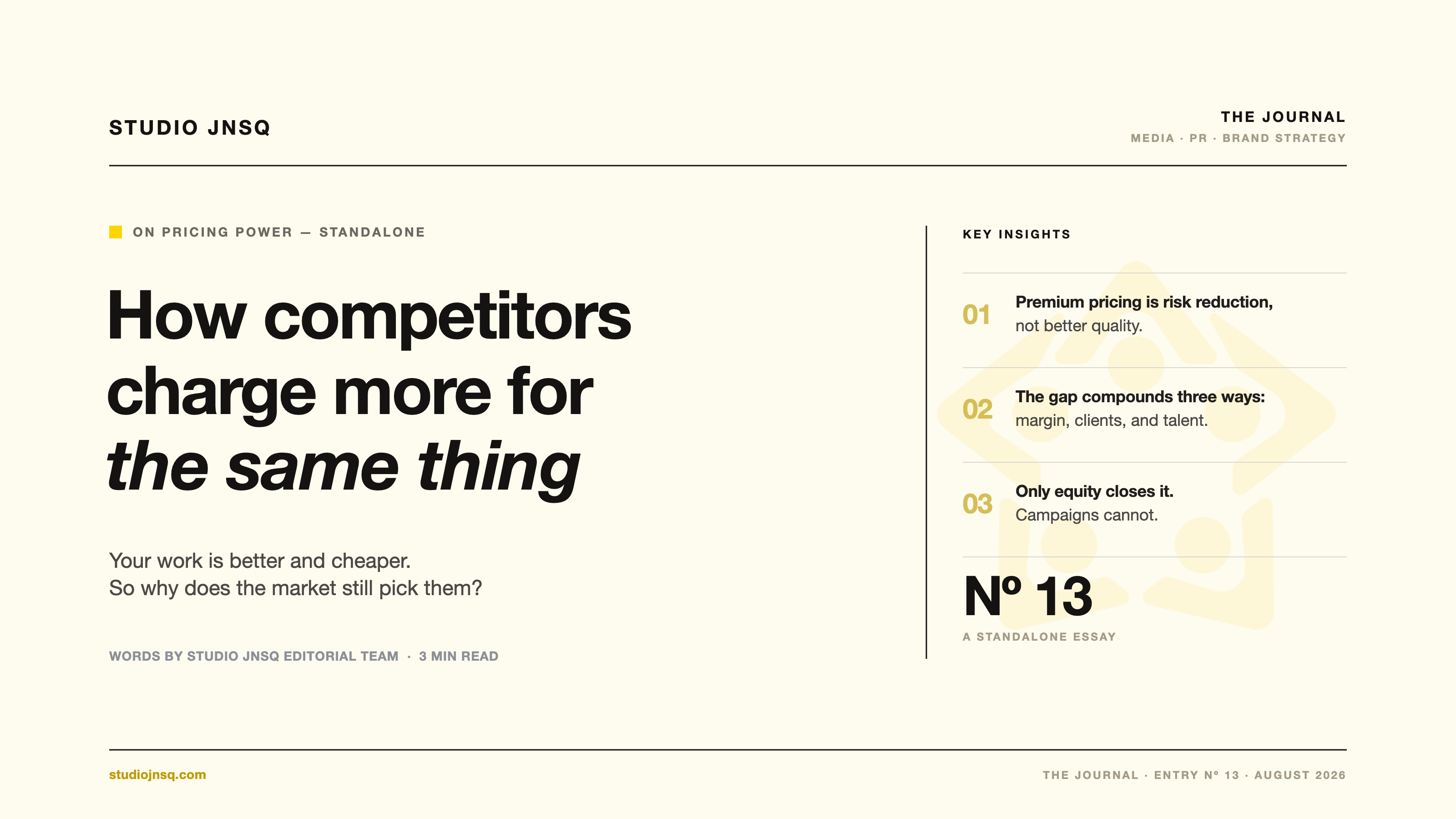
Your competitor charges double for the same work. Same credentials, same deliverables, same market. Their pipeline is full. You know your output is at least as good; maybe better. So what exactly are they selling that you are not?
What are buyers paying for when they pay a premium?
Not output. That is the uncomfortable truth. Buyers often cannot evaluate quality before they purchase; they are not experts in your craft or methodology. What they can evaluate, clearly and immediately, is risk.
When a buyer hires a premium provider, they are making a decision they can defend. If the engagement fails, they need to be able to say they hired the best-positioned firm in the space. That defensibility is worth real money. Kantar's research on pricing power confirms the mechanism: to justify paying more, people must feel they are getting something from that brand they cannot get elsewhere. Price itself explains only about 27% of pricing power perception; the rest is brand equity.
Higher-equity brands feel safer to choose. Their track record is more visible, their position in the market is clearer, and their name carries weight when the decision is being reviewed. The premium is not for better work; it is for reduced exposure on the part of the buyer.
Understanding that distinction changes how you think about what you need to build.
Why does the pricing gap get wider over time?
Once a brand achieves pricing power, three compounding advantages take hold:
Margin headroom for reinvestment. A brand charging 2x has more margin to invest in the things that reinforce their position: case studies, content, partnerships, speaking. The brand at market rate is running lean and falling further behind on authority signals.
Client quality filtering. Higher prices attract clients who are serious, well-resourced, and tend to produce better outcomes. Better outcomes produce better case studies. Better case studies attract better clients. The flywheel only runs in one direction.
Talent attraction. Strong brands attract stronger people, because the best practitioners want their name associated with the best-positioned firms. Stronger talent produces stronger work. Interbrand's research on brand and share price shows this effect at scale: brands with the strongest equity consistently outperform in both talent acquisition and market valuation.
Once equity leads, the financial advantages fund further equity. The gap does not stay flat; it accelerates.
Can you close the pricing gap with competitors?
It is never too late. But you cannot campaign your way there. Running more ads, producing more content, or redesigning your website does not close a structural pricing gap. Those are visibility plays, and visibility without authority does not build pricing power.
Brand equity architecture is the discipline of building structural authority: the credibility, the positioning, the market trust that makes your price defensible. It starts with an honest diagnostic of where you are right now.
"Direction with speed: the two coexisting harmoniously. You need a clear direction, and then the discipline to move with intention rather than activity." — Jerico Lugo, Founder, Studio JNSQ
Next up, we begin The Practice, a two-part series on building brand equity with real constraints: small budgets and founder-led brands that need to scale. Part 1 drops Thursday, August 7.
— Jec