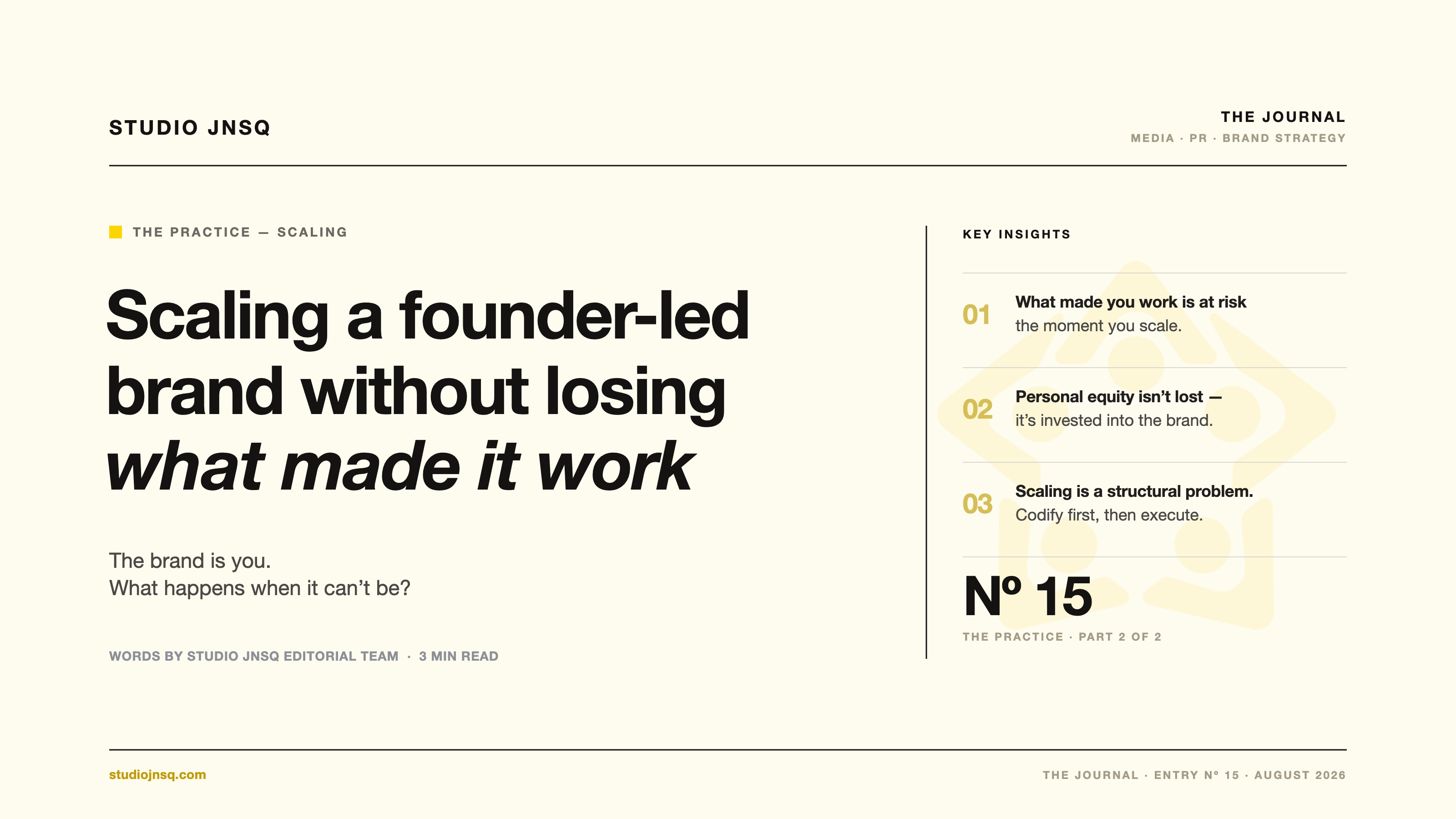
This is the final installment of The Practice. In Part 1, we covered building brand equity on a small budget. Now: the founder-led brand paradox, and how to scale without breaking the thing the market bought.
The thing that got you here is the same thing that is keeping you stuck. Your clients came because of you: your expertise, your reputation, your personal relationships. Now you want to scale, but every new hire dilutes the thing the market bought. This is the founder-led brand paradox. We see this pattern constantly. A founder builds something genuinely valuable through deep expertise, strong relationships, and a distinctive way of thinking. The market responds. Revenue grows. And then the question of scale arrives, and the founder discovers that what they built is not transferable. Not yet. Because what they built lives in their head, their reputation, and their relationships, rather than in the architecture of the brand.
Why does scaling feel like it breaks the brand?
Because for most founder-led brands, the brand is the founder. The positioning reflects the founder's perspective. The credibility is built on the founder's track record. The delivery is personal: clients chose this founder specifically. When you try to scale that, you are not scaling a brand; you are trying to clone a person.
The brands that feel broken after scaling are the ones where the founder's equity was never transferred into a structural brand architecture. McKinsey's research on scaling founder-led companies puts a number on it: 78% of companies that have successfully built a product and found product-market fit fail to scale. The transition from founder-led to industrialized scalability is where most break down.
Your brand is not only your logo and colors; it is a whole architecture of every single thing you have.
That includes how you think, how you deliver, what you stand for, and how every person on your team represents those things. When that architecture exists only in your head, scaling breaks the brand. When it is codified into a structure your team can operate within, scaling reinforces it.
How do you transfer personal equity into brand equity?
The transfer starts with articulation. Document the things that currently live only in your judgment: your positioning, your delivery philosophy, your quality standards, your decision-making framework. This is not about creating a style guide. It is about making the implicit architecture of your brand explicit, so it can be taught, maintained, and scaled.
The second step is understanding which personal equity elements are transferable and which are not. Your specific relationships are not transferable. Your approach to relationships might be. Your individual expertise is not fully transferable. Your methodology, frameworks, and way of diagnosing problems can be. Bain's research on founder-led companies confirms the pattern: companies that maintain the founder's mentality as they grow are four to five times more likely to be top-quartile performers.
The third step is building the systems that let the brand deliver on its architecture consistently without you in every room. Hiring to the architecture, not the job description. Onboarding that transmits values and delivery standards, not process alone. A quality system that catches gaps before clients do.
What does a successfully scaled founder-led brand look like?
The clearest signal: clients stay through team changes. They were not loyal to you personally; they are loyal to the brand experience, which is now consistent regardless of who delivers it.
The second signal is that new clients, who have never met the founder, describe the brand in the same terms longtime clients use. The positioning is clear, the delivery is consistent, and the market perception matches the brand architecture, all without the founder being in the room.
The third signal is pricing power that is not dependent on the founder's personal involvement. If the market will pay a premium for your brand even when you are not the one delivering, the brand has built its own equity. HBR's analysis of post-founder transitions highlights the risk: founder CEO transitions carry two to three times greater risk of performance downturn. The architecture work reduces that risk.
The MAD™ diagnostic shows you where your brand authority currently lives. If it is concentrated in the founder, the diagnostic reveals that pattern. If it has begun to transfer into structural brand equity, the scores reflect that shift.
"Personal equity is not lost in the transition to brand equity. It is invested. The founder's identity, values, and point of view become the architecture the brand is built on, not the person who delivers it." — Jerico Lugo, Founder, Studio JNSQ
That wraps The Practice. Next up is a standalone edition before we begin The Diagnostics. Dropping Sunday, August 9.