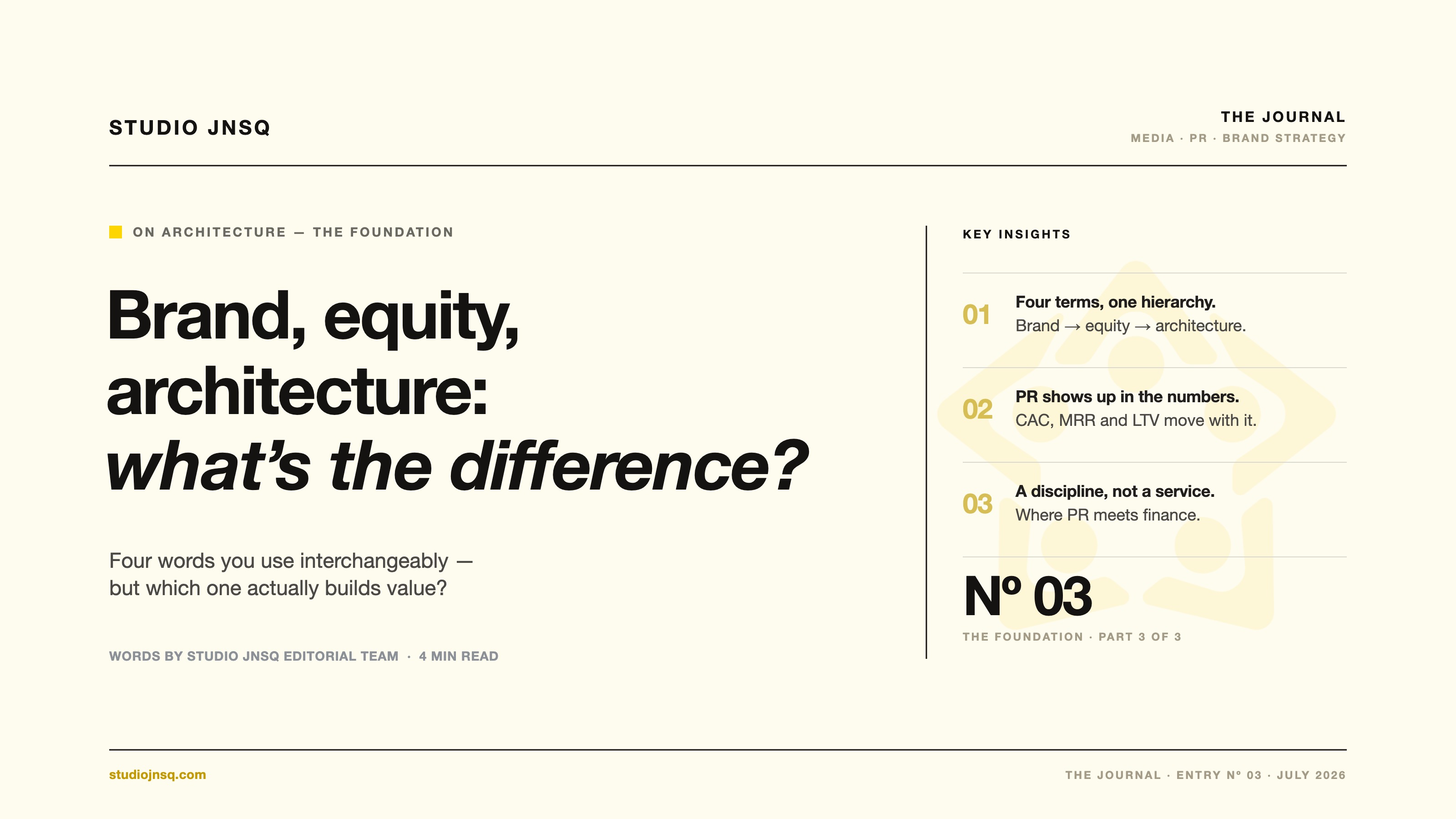
I was in a meeting last year where someone used "branding" and "brand equity" interchangeably three times in five minutes. Nobody corrected them. Everyone nodded along. That confusion is expensive. When you cannot name the problem accurately, you cannot solve it. You end up hiring a designer when you need a strategist. You end up rebranding when you need to restructure how the market perceives your value. This article defines all four terms clearly so you never confuse them again.
What is a brand?
A brand is the entity. It is the company, product, or person offering something to the market. Every business has one whether they have managed it or not. Your brand is the sum of what people believe about you: your reputation, your promise, and the experience you deliver.
What is brand equity?
Brand equity is the financial premium the market assigns to your brand. It is measurable. It is real. Ocean Tomo’s research shows intangible assets including brand equity now account for 90% of the S&P 500’s total market value, up from 17% in 1975.
Think of it this way: two companies offer the same service at the same quality level. One sells for 4x revenue. The other sells for 2x. The difference is brand equity. Deloitte’s analysis of brand valuation shows that brand equity can account for 30% to 70% of total enterprise value across industries.
What is brand architecture?
Brand architecture is how a company organizes its portfolio of brands. Procter & Gamble owns Tide, Gillette, and Pampers. That is a house of brands. Apple sells everything under one name. That is a branded house. Brand architecture is structural. It answers the question: how do our offerings relate to each other?
Important but limited. Architecture tells you how to organize. It does not tell you how to build value.
What is brand equity architecture?
Brand equity architecture is the discipline of building the financial and reputational value of a company. It sits at the convergence of PR and Finance. It is not a deliverable. It is not a one-time project. It is the ongoing strategic work of making your brand more valuable.
McKinsey’s research on brand relevance confirms that companies with strong brand equity consistently outperform competitors on revenue growth and margin resilience. That outperformance does not happen by accident. It is architected.
Brand equity architecture is the discipline of building the financial and reputational value of a company. It sits at the convergence of PR and Finance.
What this means: “The problem you think you have and the problem you actually have are often different.”
Dated visual identity → branding problem. Solve with design and messaging.
No market premium → brand equity problem. Solve with strategic positioning and trust-building.
Products cannibalizing each other → brand architecture problem. Solve with portfolio restructuring.
Everything looks right but pricing is flat, clients are leaving, and growth has stalled → brand equity architecture problem. Solve with systems that compound.
If you are spending on brand without building equity, you are funding marketing theater instead of enterprise value.
Branding gets you in the room. Brand equity gets you better terms once you are there. The work is not interchangeable, and neither are the outcomes.
- Smaller companies use brand equity architecture to command premium pricing and close faster against incumbents with bigger budgets.
- Bigger companies use it to justify valuation multiples, reduce customer acquisition cost, and create defensible moats that survive leadership transitions.
"People have neglected PR for decades because they assumed there was no way to measure it. But the numbers were always there. CAC, MRR, LTV. A good brand equity architecture results in lower acquisition cost, higher recurring revenue, and trust that compounds instead of resetting after every campaign." — Jerico Lugo, Founder, Studio JNSQ
If you are unsure which problem you are solving, the diagnostics will tell you. The MAD™ diagnostic measures market authority across four facets. The RVF™ diagnostic measures resource allocation for service-based businesses.
Take the MAD™ Diagnostic or the RVF™ Diagnostic.
— Jec