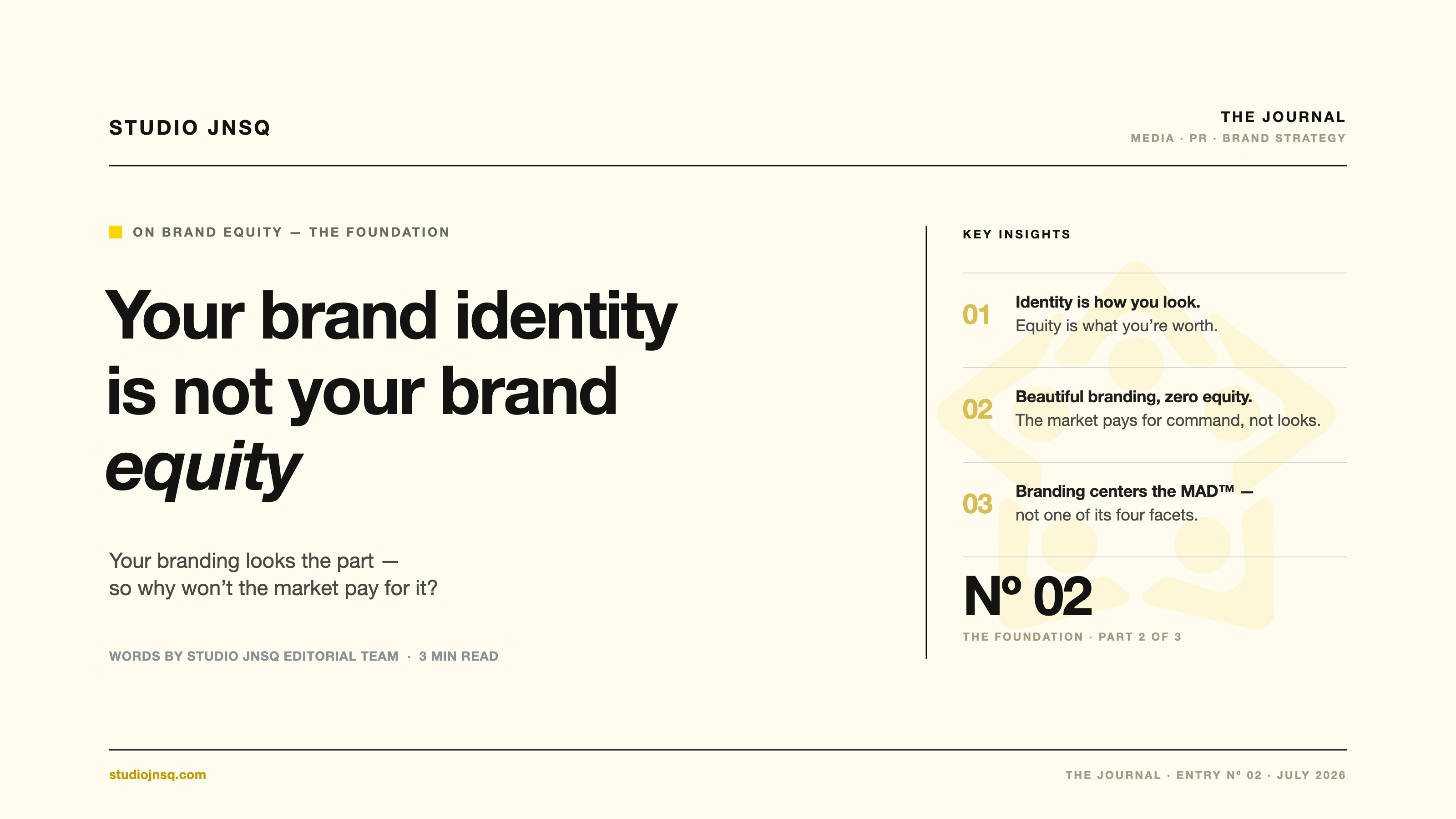
You approved the new logo. You signed off on the color palette, the typography, the brand guidelines deck. The agency delivered everything on time. Three months later, nothing changed. Pipeline looks the same. Pricing power has not moved. Clients still negotiate you down. The rebrand was not the problem. The expectation was.
You just spent $50,000 on a rebrand. Why has nothing changed?
Brand identity signals consistency. Research by Lucidpress found that consistent brand presentation across all platforms can increase revenue by up to 23%. Done well, identity earns you a seat at the table. It makes you recognizable. It tells the market you are professional and intentional.
But identity does not build pricing power. It does not lower your customer acquisition cost. It does not raise your exit multiple. Those outcomes require a different kind of work entirely.
What is the difference between brand identity and brand equity?
Brand identity is the visible layer: logo, colors, typography, messaging, tone of voice. It is what people see.
Brand equity is the financial premium the market assigns to your company because of what your brand represents. Kantar BrandZ’s valuation methodology measures brand equity as the dollar amount a brand contributes to overall business value, separating it entirely from visual identity metrics.
You can have a Pinterest-worthy aesthetic and still be showing up to every pitch because the market does not trust your company without you in the room.
The market is not paying for how you look. It is paying for what you have built in the minds of buyers, decision-makers, and the people who refer business to you.
How do you know if you need branding or brand equity work?
Kevin Keller’s Brand Report Card in Harvard Business Review identified that the strongest brands excel at delivering benefits customers truly desire, not just looking the part. The diagnostic question is simple:
What this means: “If your visual identity were stripped tomorrow and replaced with a generic template, how much of your business would still work?”
If most survives → equity is in the structure underneath. Your brand has built trust, demand, and credibility that exist independently of the logo.
If almost none survives → equity was identity-deep. It was never really equity at all.
The MAD™ diagnostic scores this precisely. Branding sits at the center as the centering point. The four facets that build actual equity are Demand, Credibility, Visibility, and Market Trust. Each is measured independently.
Identity work and equity work require different investments, different timelines, and different measures of success.
Identity signals consistency and prevents friction. Equity builds pricing power, lowers customer acquisition cost, and raises exit multiples. Confusing the two is one of the most expensive mistakes you can make in business.
- Smaller companies use brand equity architecture to stop competing on price and start commanding premium positioning before their first exit conversation.
- Bigger companies use it to raise valuation multiples, reduce dependence on founder presence, and build transferable market authority that survives leadership transitions.
"Nothing is inherently good or bad. A luxury brand distributing through TikTok might build awareness, but if the goal is direct sales, the market simply is not there. Branding becomes your centering point: the doctrine that qualifies everything as aligned or not." — Jerico Lugo, Founder, Studio JNSQ
If you want to know where your brand equity actually stands, take the diagnostic. It takes five minutes and scores all four facets plus branding as centering point.
Take the MAD™ Diagnostic or the RVF™ Diagnostic.
— Jec