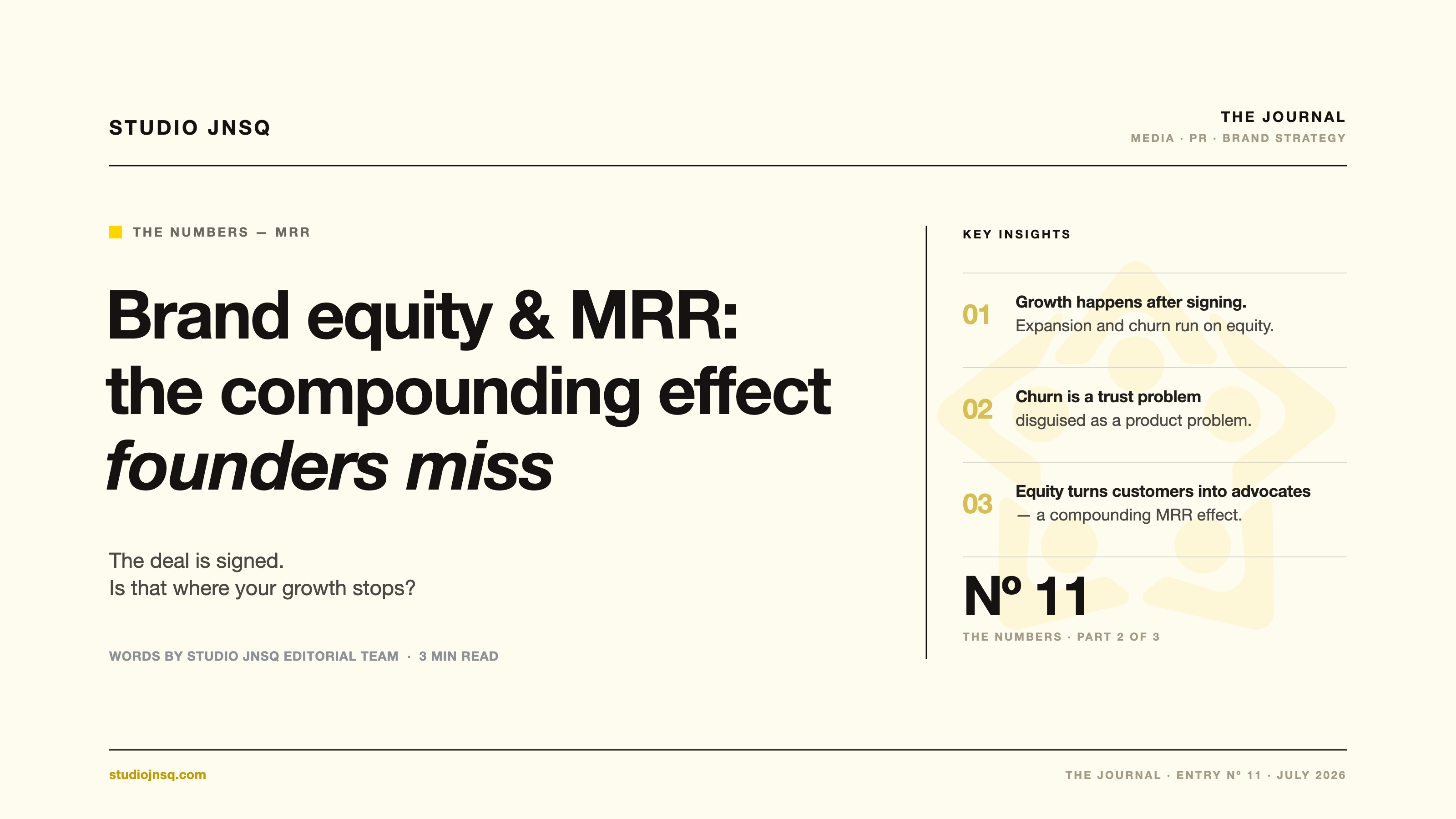
Your MRR is growing at 3% month over month. Solid, not spectacular. You are focused on acquisition, on new logos, on pipeline. But the biggest lever for MRR growth is not new customers; it is what happens after they sign. Expansion revenue, upsells, and reduced churn are all driven by brand equity. This is the MRR lever most founders miss because it is invisible in a way that acquisition is not. You can see your funnel, measure your pipeline, track your conversion rate. What is harder to see is the slow erosion of customer lifetime value that happens when brand equity is weak, or the compounding expansion that happens when it is strong.
Why does brand equity affect MRR more than marketing does?
Marketing drives acquisition. Brand equity drives retention, expansion, and referral. In a subscription or recurring revenue model, the math is straightforward: the longer a customer stays and the more they spend over time, the higher their lifetime value and the lower the effective cost of acquiring them.
The relationship between brand equity and retention is not abstract. When a customer trusts a brand, they are more likely to expand their engagement, try new offerings, refer peers without being asked, and stay through periods of friction that would otherwise trigger churn. Bain & Company research quantifies this: a 5% increase in customer retention can boost profits between 25% and 95%.
That range reflects how dramatically compounding works in recurring revenue businesses. A customer who stays an extra year, expands their contract once, and refers one new customer has delivered three to five times the value of a customer who churned at month six. Brand equity is what creates the conditions for that first scenario.
How does trust compound into recurring revenue?
Trust compounds through three mechanisms in a recurring revenue context:
Expansion. Customers who trust the brand are significantly more likely to add services, increase their contract size, or move into higher-tier offerings. The decision to expand feels lower-risk when the underlying trust is strong.
Churn reduction. Churn is often a brand trust problem disguised as a product problem. When customers leave, they frequently cite product issues or price sensitivity, but the underlying cause is often that the brand did not live up to the promise they bought. HBR's analysis of short-term revenue vs. customer fit reinforces this: prioritizing acquisition over relationship integrity creates churn at the source.
Referral. A customer who trusts a brand becomes an advocate, and advocate referrals convert at dramatically higher rates than any other acquisition channel. When trust compounds into advocacy, each existing customer becomes an acquisition asset.
When trust compounds into advocacy, MRR grows without proportional increases in acquisition spend.
What does MRR look like when brand equity is strong versus weak?
When brand equity is weak, MRR becomes a treadmill. You acquire at a certain rate, churn at a certain rate, and the net growth is the gap between them. Increasing growth requires increasing acquisition spend, which compresses margin. The model is always straining to run faster just to stay in the same place.
When brand equity is strong, MRR has a different shape. Churn decreases, so existing revenue compounds rather than leaking. Expansion revenue increases, so existing customers contribute to growth without acquisition cost. Referral rates rise, so new acquisition becomes cheaper. Nielsen's research on long-term marketing shows the pattern clearly: brands that stop investing in long-term brand building lose 2% in future revenue for every quarter they go dark.
The clearest indicator of brand equity strength in a recurring revenue business is net revenue retention: the percentage of revenue retained from existing customers, including expansion, after churn. A business with strong brand equity often has net revenue retention above 100%, meaning existing customers alone are growing the business. That is the compounding effect of brand equity made visible in the numbers.
"Recurring revenue is shaped far more by brand equity than by the initial sale. The difference between a founder stuck at $10k MRR and one scaling to $100k is not the sales process. It is how strong the brand is." — Jerico Lugo, Founder, Studio JNSQ
Up next in The Numbers: The LTV Multiplier, why brand equity is your best long-term investment. Final installment drops Saturday, August 2.
— Jec