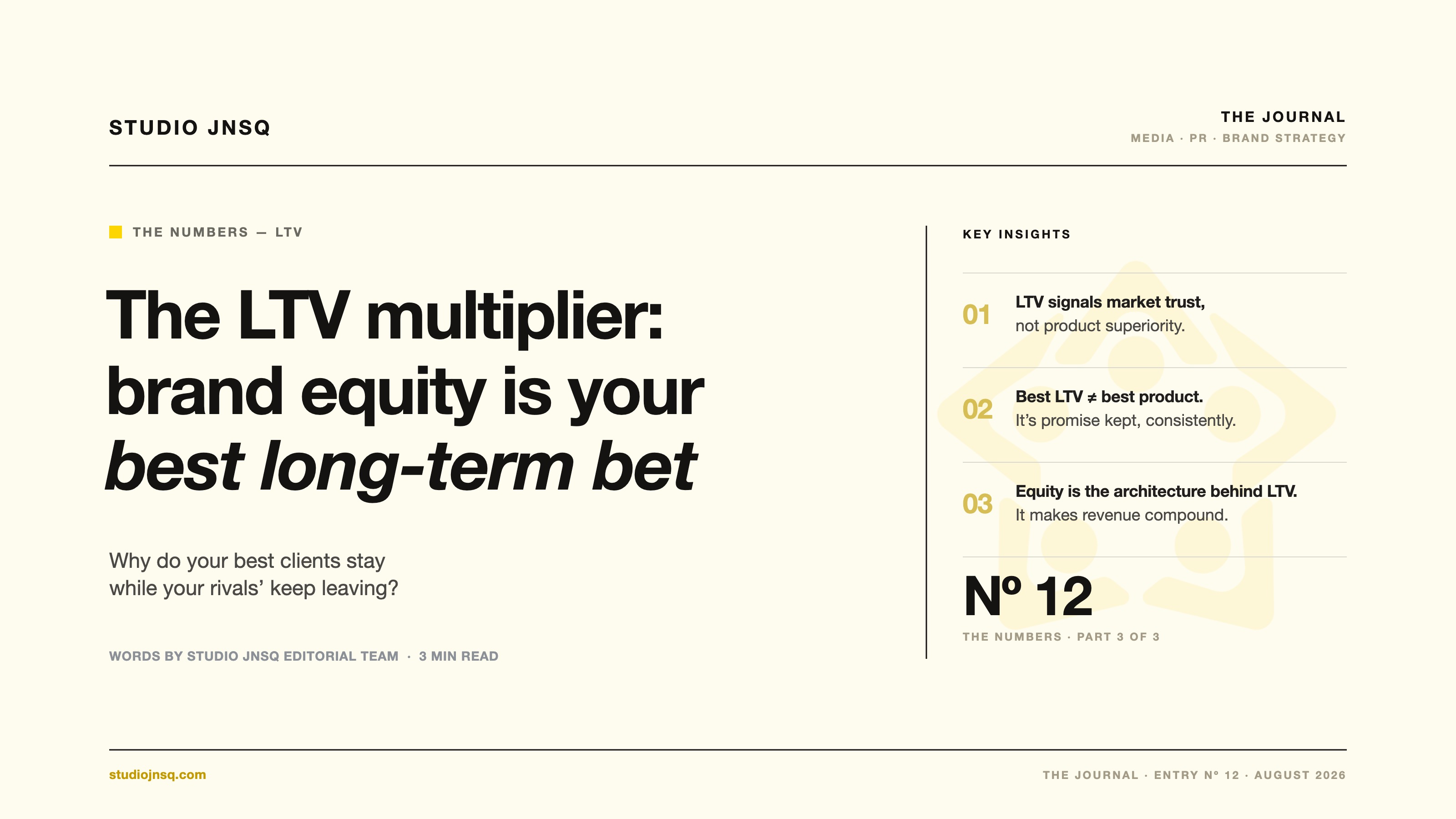
This is the final installment of The Numbers. We have covered CAC and MRR. Now: lifetime value, and why brand equity is the multiplier most founders overlook.
You are spending most of your budget acquiring new customers. Every quarter, the acquisition machine runs, the numbers look okay, and you do it again. But the real growth lever is not in the front door; it is in what happens after someone walks through it. Lifetime value is where brand equity shows its clearest financial return. Most founders treat LTV as a calculation: average revenue per customer divided by churn rate, maybe adjusted for gross margin. That is a useful number. But it tells you what happened, not why. And unless you understand why your LTV is where it is, you cannot systematically improve it. The answer to why almost always points back to brand equity.
Why does brand equity affect how long customers stay?
Retention is a trust problem. Customers stay when they trust that the brand will continue delivering what they came for. They leave when that trust breaks, when expectations are not met, when a competitor offers something that seems more reliable, or when the accumulated experience no longer matches the promise. Each of those exit scenarios is a brand equity failure.
Brand equity creates what you might call switching friction, but the healthy kind. Not the kind built on contracts or technical lock-in, but the kind built on a relationship so consistent and valuable that leaving feels like a loss. That is what strong brand equity does: it raises the emotional and practical cost of leaving, not through manipulation, but through genuine accumulated value.
A customer who trusts your brand tolerates more friction. They absorb a billing issue or a delayed delivery without churning, because the relationship has enough stored goodwill to handle it. A customer with weak brand trust churns at the first sign of trouble because there is nothing in reserve. Over time, that difference compounds significantly into your LTV numbers.
How does trust turn into expansion revenue?
Expansion revenue, meaning upsells, cross-sells, and contract growth, is the clearest financial signal of brand equity strength. A customer who trusts you does not need to be sold to again in the same way a new prospect does. The trust already exists. The decision to expand feels lower-risk because they have already experienced you delivering on your promises.
This is why the relationship between brand equity and LTV is not linear. It compounds. A customer who expands their engagement with you once is significantly more likely to expand again. Each positive experience reinforces the trust, which lowers the perceived risk of the next expansion, which creates another positive experience. The architecture of brand equity makes this cycle possible; without it, every upsell conversation starts from scratch.
The brands that see the highest expansion revenue are also the brands with the clearest, most consistent positioning. When customers know exactly what you stand for and you consistently deliver on it, they naturally think of you first when a new need arises that falls within your positioning. That is brand equity doing the work that a sales team would otherwise have to do.
What does high LTV look like when brand equity is strong?
The clearest indicator is net revenue retention above 100%. That means your existing customer base, even accounting for churn, is growing its spend over time. The brands that achieve this are not doing it through aggressive upselling or contract manipulation; they are doing it because their brand equity creates the conditions for expansion to happen organically.
Strong brand equity also shows up in referral behavior. Customers with high brand trust become advocates, and advocates generate referrals that convert at dramatically higher rates than any other acquisition channel. When you factor referred customers into your LTV calculation, the numbers shift significantly: a customer who refers two new customers has contributed far more value than their own revenue alone would suggest.
The long-term picture is this: businesses with strong brand equity do not just have higher LTV on average; they have a different LTV distribution. Their top customers stay much longer, spend much more, and refer more actively than the top customers of comparable businesses with weaker brand equity. That difference is not explained by product quality or pricing; it is explained by the trust architecture the brand has built over time.
Brand equity turns your existing customer base into a compounding revenue engine, not just a retention metric.
Most businesses measure LTV as a backward-looking number. But when you architect brand equity intentionally, LTV becomes a forward-looking growth lever. The trust you build today determines whether customers expand, refer, and stay tomorrow.
- Smaller companies use it to achieve net revenue retention above 100% without aggressive upselling, making every cohort more valuable over time.
- Bigger companies use it to raise exit multiples, because buyers pay premiums for predictable, compounding LTV driven by brand equity, not contracts.
"Strong brand equity raises the emotional and practical cost of leaving, not through manipulation, but through genuine accumulated value." — Jerico Lugo, MCIPR, Founder, Studio JNSQ
If you want to see where your brand equity stands today, run the MAD™ diagnostic to map your market authority, or the RVF™ diagnostic to understand your revenue-valuation fit. Both take under ten minutes and give you a starting point for building the architecture that compounds LTV.
— Jec