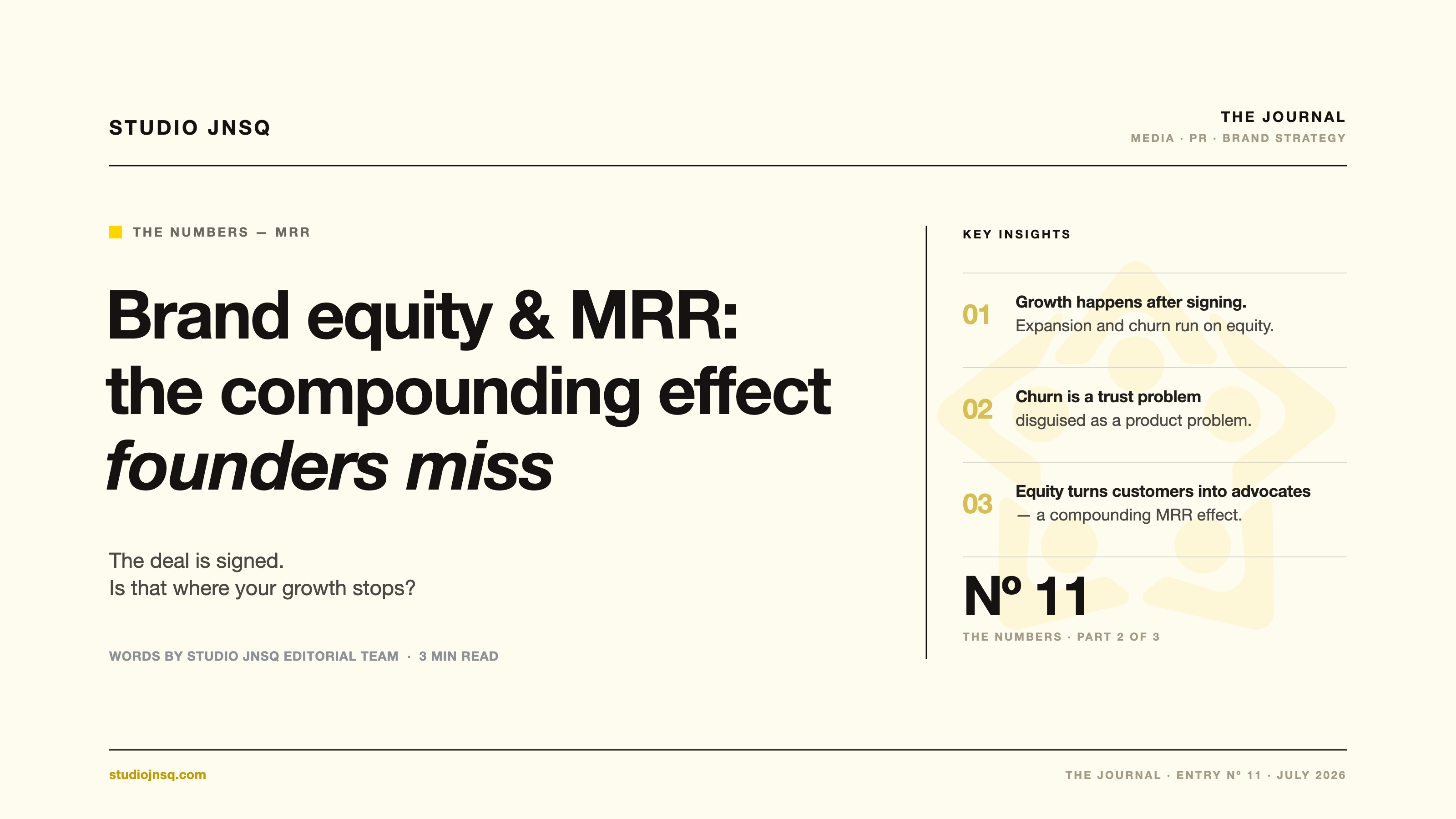
This is Part 2 of The Numbers. In Part 1, we covered how brand equity lowers your customer acquisition cost. Now: how it compounds into monthly recurring revenue.
Your MRR is growing at 3% month over month. Solid, not spectacular. You are focused on acquisition, on new logos, on pipeline. But the biggest lever for MRR growth is not new customers; it is what happens after they sign. Expansion revenue, upsells, and reduced churn are all driven by brand equity. This is the MRR lever that most founders miss because it is invisible in a way that acquisition is not. You can see your acquisition funnel. You can measure your pipeline, your conversion rate, your close time. What is harder to see is the slow erosion of customer lifetime value that happens when brand equity is weak, or the compounding expansion that happens when it is strong. Those effects show up in your MRR months and quarters after the decisions that caused them.
Why does brand equity affect MRR more than marketing does?
Marketing drives acquisition. Brand equity drives retention, expansion, and referral. In a subscription or recurring revenue model, the math is straightforward: the longer a customer stays and the more they spend over time, the higher their lifetime value and the lower the effective cost of acquiring them in the first place.
The relationship between brand equity and retention is not abstract. When a customer trusts a brand, they are more likely to expand their engagement with it, to try new offerings, to refer peers without being asked, and to stay through periods of friction that would otherwise trigger churn. That trust is not built through marketing; it is built through every touchpoint the brand controls, from onboarding to delivery to how problems are handled when they arise.
Harvard Business Review research quantifies this: a 5% increase in customer retention can boost profits between 25% and 95%. That range reflects how dramatically compounding works in recurring revenue businesses. A customer who stays an extra year, expands their contract once, and refers one new customer has delivered three to five times the value of a customer who churned at month six. Brand equity is what creates the conditions for the first scenario.
How does trust compound into recurring revenue?
Trust compounds in a recurring revenue context through three mechanisms. The first is expansion: customers who trust the brand are significantly more likely to add services, increase their contract size, or move into higher-tier offerings. The decision to expand feels lower-risk when the underlying trust is strong, because the customer has already experienced the brand delivering on its promises.
The second mechanism is churn reduction. Churn is often a brand trust problem disguised as a product problem. When customers leave, they frequently cite product issues or price sensitivity, but the underlying cause is often that the brand did not live up to the promise they bought. They trusted the promise, the delivery did not match the trust that was established, and the gap eroded their confidence. Addressing the brand equity system that created that gap reduces churn at the source rather than treating the symptom.
The third mechanism is referral. A customer who trusts a brand becomes an advocate, and advocate referrals convert at dramatically higher rates than any other acquisition channel because the trust has already been established peer-to-peer. When trust compounds into advocacy, each existing customer becomes an acquisition asset. That is how MRR growth accelerates without proportional increases in acquisition spend.
What does MRR look like when brand equity is strong versus weak?
When brand equity is weak, MRR becomes a treadmill. You acquire at a certain rate, you churn at a certain rate, and the net growth is the gap between them. Increasing growth requires increasing acquisition spend, which increases cost, which compresses margin. The model is always straining to run faster just to stay in the same place.
When brand equity is strong, MRR has a different shape. Churn decreases, which means existing revenue compounds rather than leaking. Expansion revenue increases, which means existing customers contribute to growth without acquisition cost. Referral rates rise, which means new acquisition becomes cheaper because advocates are doing pre-selling work. The total effect is a growth curve that accelerates without proportional increases in spend.
The clearest indicator of brand equity strength in a recurring revenue business is net revenue retention: the percentage of revenue retained from existing customers, including expansion, after churn. A business with strong brand equity often has net revenue retention above 100%, meaning existing customers alone are growing the business without a single new logo. That is the compounding effect of brand equity made visible in the numbers.
Brand equity turns MRR into a compounding asset, not a linear growth target.
When brand equity is weak, your MRR grows through acquisition alone, which means you are always replacing churn with expensive new logos. When brand equity is strong, your MRR compounds through retention, expansion, and referral, which means every dollar you spend on acquisition delivers three to five times the lifetime value. The difference shows up in your valuation multiples and your ability to command pricing power without triggering churn.
- Smaller companies use it to reduce churn and extend payback periods, making every acquisition dollar stretch further into profitability.
- Bigger companies use it to drive expansion revenue and command premium pricing, which increases ARPU and compresses the sales cycle on upsells.
"Marketing drives acquisition. Brand equity drives retention, expansion, and referral. The difference shows up in your MRR months and quarters after the decisions that caused it." — Jerico Lugo, MCIPR, Founder, Studio JNSQ
If your MRR is growing but churn is creeping up or expansion is flat, the issue is not your product or your sales team. It is your brand equity. Run the MAD™ diagnostic to see where your Market Authority Diamond is under-indexed, or the RVF™ diagnostic to understand where your brand equity is leaking value. Both take under ten minutes and show you exactly where to focus.