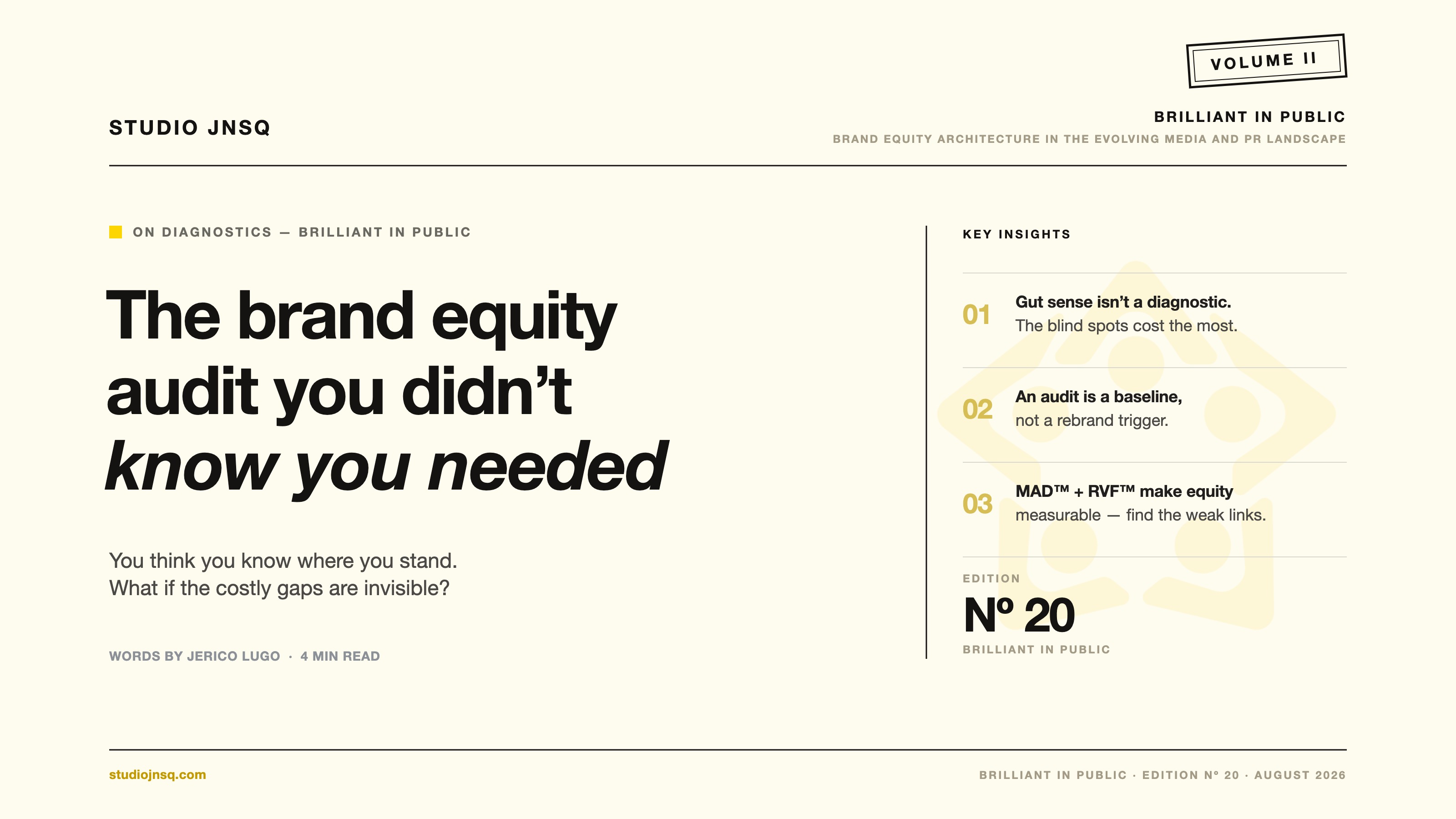
In the last edition, we talked about why clients leave and what brand equity has to do with the relationships you assumed were solid. This one is the practical follow-up: a systematic checklist for auditing where your brand stands, not where you think it stands. Most founders I work with think they know where their brand stands. They have a sense, a gut feeling, sometimes a few metrics they check. But when I ask them to walk me through it systematically, the gaps become obvious fast. Here is the checklist I use. This is not a rebrand checklist. It is not a marketing audit. It is a brand equity diagnostic: a structured way of looking at the architecture of your brand and identifying where the gaps are between what you intend and what the market actually experiences. The goal is not to find things to fix; it is to find out where you actually are, so that every decision you make from that point is grounded in reality rather than assumption.
What should you check in a brand equity audit?
We need first to check where you are, not where you were, not where you want to be, but where you are presently. That principle drives the structure of the audit. It has five areas, which correspond to the four facets and the centering point of the MAD™ diagnostic: Demand, Credibility, Visibility, and Market Trust, with Branding as the centering point.
Demand: Is there evidence of organic inbound interest in what you do, not just responses to outbound effort? Are you being found, referenced, recommended, or sought out by people who did not previously know you? Demand in the brand equity sense is not the same as pipeline. It is the market's active pull toward your brand. If most of your business comes from outbound effort, your demand facet needs attention.
Credibility: What does the market see when it looks for evidence that you can do what you say you can? This includes media presence, publications, third-party validation, case studies with real specificity, and the quality of your thought leadership. Credibility is not what you claim; it is what the market can verify independently. If the only evidence of your expertise is on your own website, your credibility facet is weaker than you think.
Visibility: Are you showing up where your target market is actively looking? Not just on social media, but in the specific channels your buyers use when they are in decision-making mode. Visibility is not the same as activity. You can be very active on platforms where your buyers are not, and completely invisible in the places that actually matter.
Branding: Is your visual and verbal identity consistent, clear, and aligned with the position you want to hold in the market? Not just aesthetically, but strategically: does every element of how you present yourself reinforce the same core idea? Branding is the layer most founders over-invest in early and under-align with their actual equity strategy.
Market Trust: What is the market saying about you when you are not in the room? This includes reviews, referrals, the language your clients use when they describe you to peers, and the general sentiment in your professional ecosystem. Trust is the cumulative result of all the other facets, and it is the hardest to build and the easiest to erode.
Where do most brands have blind spots in their brand equity?
Credibility is the most common blind spot. Founders consistently overestimate how visible their expertise is to people who have not already worked with them. You know your track record. You know your depth of knowledge. But a potential client who encounters your brand for the first time only knows what they can verify externally, and for most service businesses, that verification pathway is thin.
Market Trust is the second most common. It is easy to confuse client satisfaction with market trust. Your existing clients may trust you completely. But market trust extends beyond the people you have already worked with; it includes the perception of people who have heard of you, encountered you tangentially, or seen your work from a distance. That broader trust is built differently and needs to be audited separately.
The third blind spot is the gap between Branding and the actual brand equity. Many founders invest heavily in visual identity and messaging and assume that the branding work translates into equity. It does not automatically. Branding is the surface layer. Equity is the architecture underneath it. A beautifully designed brand with weak credibility, low demand, and fragile market trust has strong branding and weak equity. The audit forces you to separate them.
What do you do once you find brand equity gaps?
You prioritize by leverage, not by urgency. The most urgent gaps are not always the highest-leverage ones, and spending your resources on the wrong facet is one of the most common strategic errors in brand equity building. The MAD™ diagnostic is designed specifically to help you identify which gaps have the highest impact on your overall market authority score, so that the resources you invest go to the right places.
Once you have your priority order, you build a structured action plan for each gap: specific, measurable actions that will move each facet, with a timeline that reflects both the urgency and the compounding nature of the work. Some facets, like Visibility, can show movement in weeks. Others, like Market Trust, build over months and years. Your plan needs to account for both timelines simultaneously.
The final step is running the diagnostic again at a defined interval, typically six months, to measure movement. Brand equity auditing is not a one-time exercise; it is a recurring practice. The market changes, your brand changes, the competitive landscape changes, and your equity position changes with it. The brands that build durable equity are the ones that audit consistently and adjust continuously rather than doing a one-time diagnostic and moving on.
TRY THIS
Score yourself honestly on these five questions, one to five: (1) Can the right people find you without a referral? (2) Can you prove your track record to someone who has never heard of you? (3) Does the market understand what you stand for in under five seconds? (4) Would clients recommend you publicly, not just privately? (5) Does inbound keep coming when you stop outreach? Add your scores. Under 15 means the audit just told you where to start. Take the MAD™ diagnostic to see the full picture.
A brand equity audit tells you whether your current positioning supports the exit multiple, pricing power, or capital terms you need.
Most founders audit financials obsessively but never audit the brand equity that drives those financials. The result: surprise when acquirers discount your valuation, clients defect over price, or investors demand punitive terms. An audit gives you the data to intervene before the market does.
- Smaller companies use it to identify the single credibility gap or visibility blind spot preventing premium pricing or investor interest.
- Bigger companies use it to quantify the market trust erosion that precedes client churn, margin compression, or a down-round.
"You can't fix what you haven't measured, and you can't measure what you haven't defined." — Jerico Lugo, MCIPR, Founder, Studio JNSQ
If you want to see where you stand across the MAD™ framework before you audit manually, run the MAD™ diagnostic. It scores your Demand, Credibility, Visibility, and Market Trust in under ten minutes. For a deeper valuation lens, pair it with the RVF™ diagnostic. Both are free, both are fast, and both give you the baseline you need before you start fixing anything.
— Jerico Lugo, MCIPR