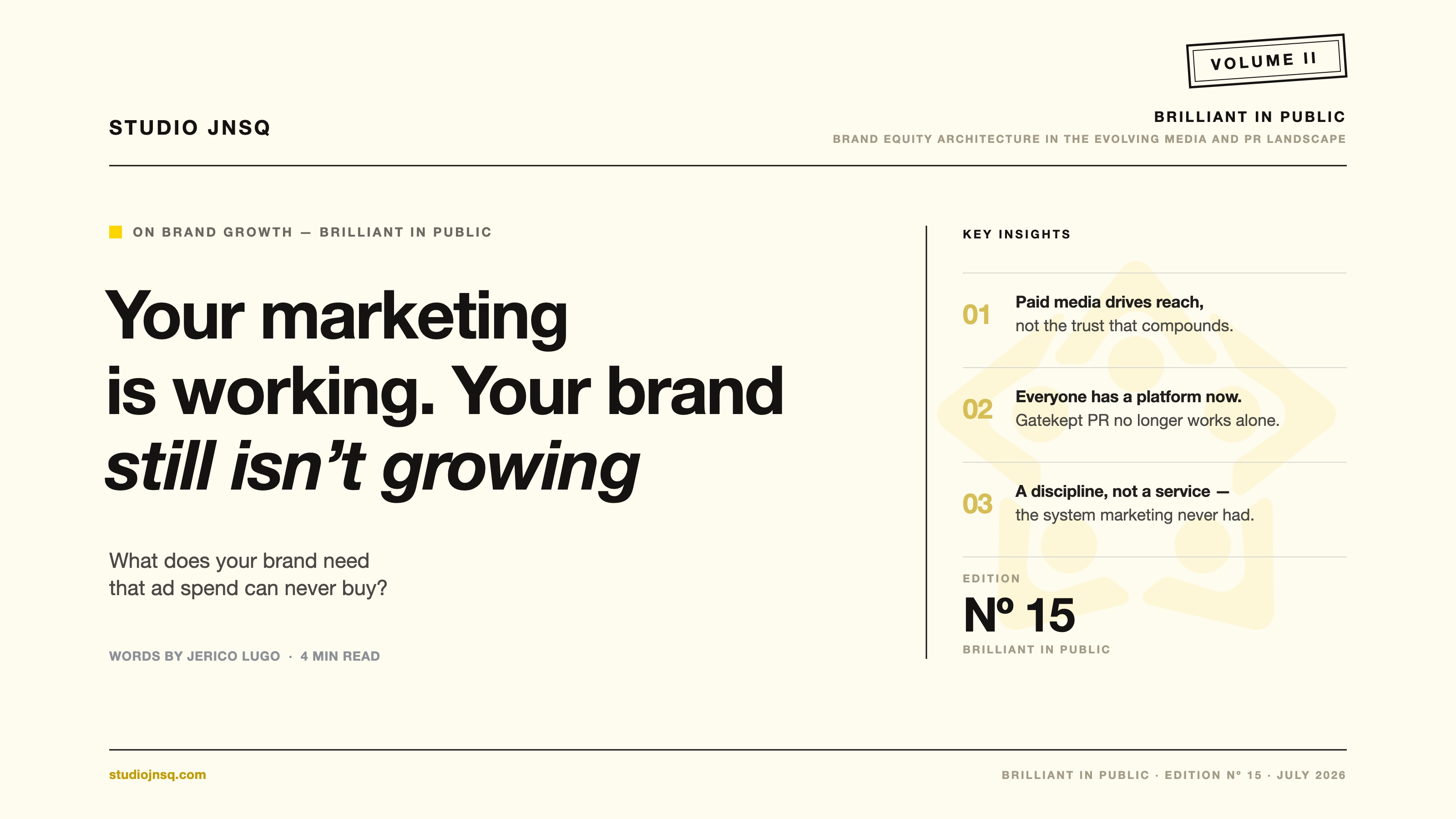
It has been a few weeks since the last edition. The break was intentional; sometimes the best thing you can do for clarity is step away from the noise and come back with sharper questions. This is the return. BIP is back, and we are picking up where it matters most: the gap between what your marketing says about your business and what the market believes. Your marketing is performing. The leads are coming in, the campaigns are hitting their numbers, and the reports look healthy. But something is off, and you can feel it even if you cannot quite name it. Clients are harder to close than they used to be. Your pricing power has not moved in two years. Competitors who frankly are not as good as you are commanding rates you cannot touch. The engine is running, but the car is not going anywhere new. I spent the first few years of my career in PR and media strategy watching this exact pattern repeat across every industry I worked in. The marketing worked. The campaigns performed. The numbers looked fine on paper. But the brands themselves were not compounding. Every quarter was a reset; stop the spend, and the pipeline dries up. Start it again, and you are essentially reintroducing yourself to a market that should already know who you are. That is not growth. That is a treadmill.
What changed in the media and PR landscape?
Two decades ago, the media channels were genuinely inaccessible. Only practitioners, the PR professionals and media strategists, had the access to shape what the public saw and believed. If you wanted to position breakfast as the most important meal of the day, which by the way had no solid scientific basis, you could do it because you had the front seat and almost nobody else did. Cereals as breakfast food, diamonds as engagement necessities; these were PR campaigns executed through gatekept media by people and institutions with exclusive access.
That world does not exist anymore. Social media gave everyone a platform, which means everyone also has a say in how any topic gets painted. The result is that people are genuinely confused now, because everyone is preaching their own doctrine. What worked before, controlling the narrative through limited channels, simply cannot work the same way when the channels are infinite and the voices are endless.
This is not a bad thing, but it does change what you need to focus on. Brand equity architecture is focused not just on making sure you are heard, seen, and understood, but on building communities, establishing trust with your consumers, and making sure you are not unnecessarily reliant on paid media. Paid media is good and it serves its purpose, but it can only do so much in terms of reach. It does very little for trust.
Why did brand equity architecture become its own discipline?
Because nothing existed to fill the gap. People have long been confused about the difference between media, marketing, advertising, and PR, and that confusion has real financial consequences. Marketing is the bigger umbrella; it is the practice of making a market aware of your existence. Advertising is direct selling through concentrated effort. PR is about building goodwill and trust, because brands know that reputation and image help with selling, although indirectly. Media is the avenue for all of it, just in different forms.
The problem is that PR has been neglected for decades compared to marketing, media, and advertising, largely because people assumed there was no way to measure it. "How do you put a number on trust?" was the question that killed PR budgets in boardrooms for years. But the numbers were always there; they just were not being connected to the right outcomes. The effects of PR show up in CAC, MRR, and LTV more clearly than anywhere else. Lower customer acquisition cost because the brand does pre-selling work before the marketing even starts. Higher monthly recurring revenue because trust-driven clients expand and stay. Higher lifetime value because the relationship compounds rather than resetting after every campaign.
I kept seeing these connections play out in my own work, but no one had a name for the discipline of building them intentionally. Brand strategists were too broad; they were focused on positioning, acquisition, customer journey, a dozen different things. What I was doing was more specific: building systems that compound trust and market value over time. Systems that, once set up, run unless there are new disruptions. That is what brand equity architecture is, and that is why Studio JNSQ exists.
What does brand equity architecture mean for your business?
It means that if your marketing is working but your brand is not growing, the problem is not your marketing. The problem is that you do not have architecture underneath it. You are generating attention without compounding trust. You are acquiring clients without building the equity that would make the next ones cheaper to acquire and longer to retain.
1. Smaller companies use brand equity architecture to get to profitability. When your brand carries trust, you spend less on paid media, you close faster, and your margins improve. The architecture does the pre-selling work that your ad budget was trying to do alone.
2. Bigger companies use it to build a stronger case for a higher valuation on exit. Acquirers are not just buying your revenue; they are buying the transferable value of your brand. A strong brand equity architecture is the difference between a 1.5x multiple and a 4x multiple in the same conversation.
"I think in systems," I tell clients, "because systems, once set up, run unless there are new disruptions. That is why brand equity architecture is focused on compounded trust, so that brands do not need to spend needlessly on paid media and other marketing campaigns just to reintroduce the brand to other markets and clients."
The question is not whether your marketing works. It is whether your brand works when your marketing stops. If you want to find out, our MAD™ diagnostic takes about five minutes and gives you a clear score across four facets of brand equity, with Branding as the centering point. If you are thinking at the business level, the RVF™ diagnostic measures how your resources are being allocated against the value you are building. Both are free to start.
TRY THIS
Pause your highest-spend marketing channel for two weeks. Not everything, just the one you spend the most on. Watch what happens to your inbound. If inquiries drop to near zero, your brand equity is thin and your marketing is doing all the heavy lifting. If inquiries hold, you have equity working underneath. Either answer tells you something important about where to invest next.
Marketing gets you leads today; brand equity gets you pricing power and valuation multiples tomorrow.
When your marketing performs but your brand equity doesn't compound, you're running a treadmill business. Stop the spend, the pipeline dries up. Competitors with weaker execution command higher rates because they've built market trust you're still renting quarter by quarter.
- Smaller companies use brand equity architecture to break through pricing ceilings and close deals faster without discounting.
- Bigger companies use it to command valuation multiples that reflect not just revenue, but the compounding trust and authority competitors can't replicate.
"Marketing that works but doesn't compound isn't growth. It's a treadmill. Every quarter is a reset because the asset you're building evaporates the moment you stop spending." — Jerico Lugo, MCIPR, Founder, Studio JNSQ
If you're wondering whether your marketing is building brand equity or just renting attention, the diagnostics will tell you. Start with the MAD™ diagnostic to map where your authority actually sits in the market, then run the RVF™ diagnostic to see whether your brand equity is compounding or evaporating quarter by quarter.
Audit your last four quarters and ask: if we stopped all paid spend tomorrow, what would still be true about our market position?
Pull your campaign reports and map what persists when the spend stops. Are you still the default choice in your category? Do clients come to you without prompting? Can you raise prices without losing deals? If the answer is no, you're renting visibility, not building equity. The fix isn't more marketing. It's designing the brand equity architecture that makes your authority compound independent of spend. Start by identifying one repeatable trust mechanism, something clients cite when they choose you over competitors, and build your next quarter's strategy around reinforcing that singular asset instead of chasing new channels.
— Jerico Lugo, MCIPR