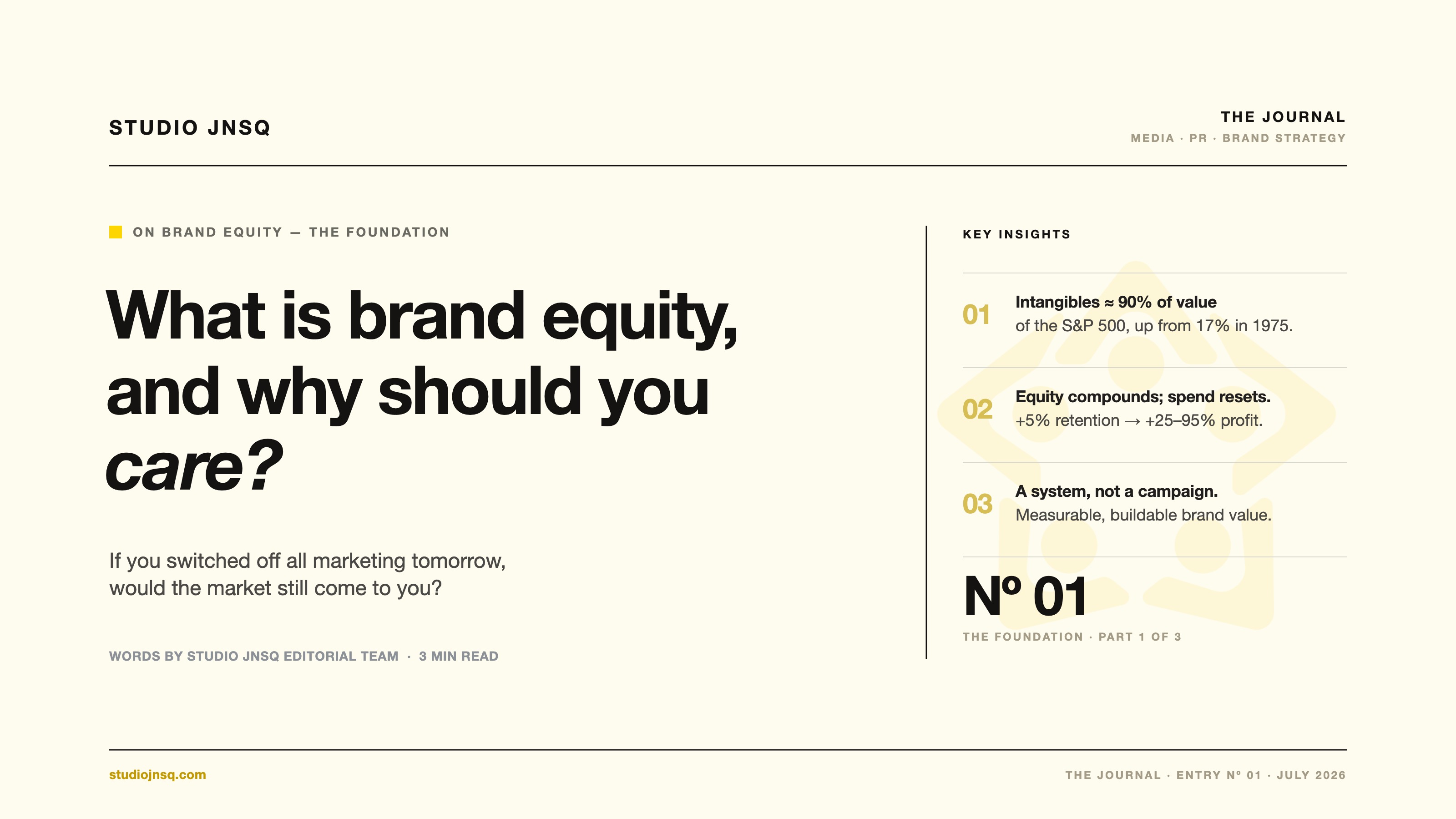
This is the first installment of The Foundation, a three-part series exploring what brand equity is, why it matters, and how it differs from branding, brand architecture, and brand equity architecture. The Foundation drops this week on Sunday, Thursday, and Saturday.
Last year, a founder I was consulting with raised his prices by 15% and lost three clients in a single week. He called me, rattled, asking if he had priced himself out of the market. Meanwhile, his biggest competitor had been charging nearly double for the same type of work, for years, and their pipeline was full. Same industry, same city, same caliber of output. The only difference was that one of them had spent years building something the other had never thought about: brand equity. This is something I see all the time, and it is more common than most business owners want to admit. You know your work is good. You might even know it is better than what the next firm is offering. But the market does not seem to care, and no amount of marketing spend seems to close the gap. The issue is not that your marketing is broken; it is that you are relying on marketing to do something only brand equity can do.
What is brand equity and why does it matter?
Brand equity is the financial value your brand holds in the market, completely independent of your products, your services, or how many hours you put in. It is the premium the market is willing to pay simply because of who you are, not what you deliver. And it is not a soft metric; according to Ocean Tomo, intangible assets including brand equity now account for 90% of the total market value of the S&P 500. In 1975, that number was 17%. The entire economy has shifted from paying for what you make to paying for what your name means.
I have been in PR and media strategy for about six years now, and what I kept seeing was this: brands that invested in trust, in relationships, in making sure the market genuinely understood what they stood for, those brands stopped needing to spend aggressively on ads and campaigns just to stay relevant. Their equity compounded. Harvard Business Review research backs this up; increasing customer retention by just 5% can boost profits by 25% to 95%. That kind of retention does not come from discounts. It comes from trust, and trust is what brand equity is made of.
How do you know if your brand has real equity?
Here is the question I ask every founder I work with, and most of them do not like the answer: if you stopped all marketing tomorrow, turned off the ads, paused the content, killed the outreach, and your existing pipeline dried up, would the market still come to you?
If yes, you have brand equity. If no, what you have is a marketing function, and those are two very different things. Brand equity compounds; it builds on itself, it grows without proportional spend, and it becomes an asset someone would pay for if they were acquiring your business. A marketing function resets every quarter you stop funding it.
As I often tell clients: "We need first to check where you are, not where you were, not where you want to be, but where you are, presently. Once we have that, we have practically done half the equation." The psychological maturity that comes with that kind of honest assessment sets business owners up to move forward with real clarity, not wishful thinking.
What does brand equity look like in practice?
One of my clients in Canada was building a prefab real estate business. He had not even fully launched yet, was not actively trying to expand into other provinces, was not running ads or outreach campaigns. But through the PR and media architecture we built together, his brand equity compounded to the point where the Canadian government found him, reached out on their own, and offered grants and projects. He did not go looking for them; they came to him. That is brand equity in action.
Another project: I helped an international bank build their media presence and search visibility from scratch, all while they were still pre-launch. That groundwork led directly to them winning an industry award before they had even officially opened their doors. None of that came from an ad budget. It came from architecture.
This is what brand equity architecture is, in practice. Not a campaign, not a rebrand, not a one-time strategy deck. It is a discipline, a system that makes sure everything your brand does, from finance to media to client relationships, works toward one goal with compounded consistency. Smaller companies use it to get to profitability. Bigger companies use it to build a stronger case for a higher valuation when exit conversations start.
Brand equity determines whether you compete on price or command a premium the market willingly pays.
Without brand equity, every client conversation starts with justifying your price. With it, prospects come pre-sold. The difference shows up in your margins, your exit multiples, and whether you can scale without burning capital on acquisition.
- Smaller companies use it to charge 20-40% more than competitors without losing deals, because the market trusts them first.
- Bigger companies use it to drive valuation multiples at exit, as acquirers pay premiums for brands with compounding trust and pricing power.
"The entire economy has shifted from paying for what you make to paying for what your name means." — Jerico Lugo, MCIPR, Founder, Studio JNSQ
If you want to know where your brand stands right now, our MAD™ diagnostic scores your brand across four facets of market authority, with Branding as the centering point, and the RVF™ diagnostic assesses how your business allocates its resources against the value it is building. Either one takes about five minutes, and both are free to start.
— Jec