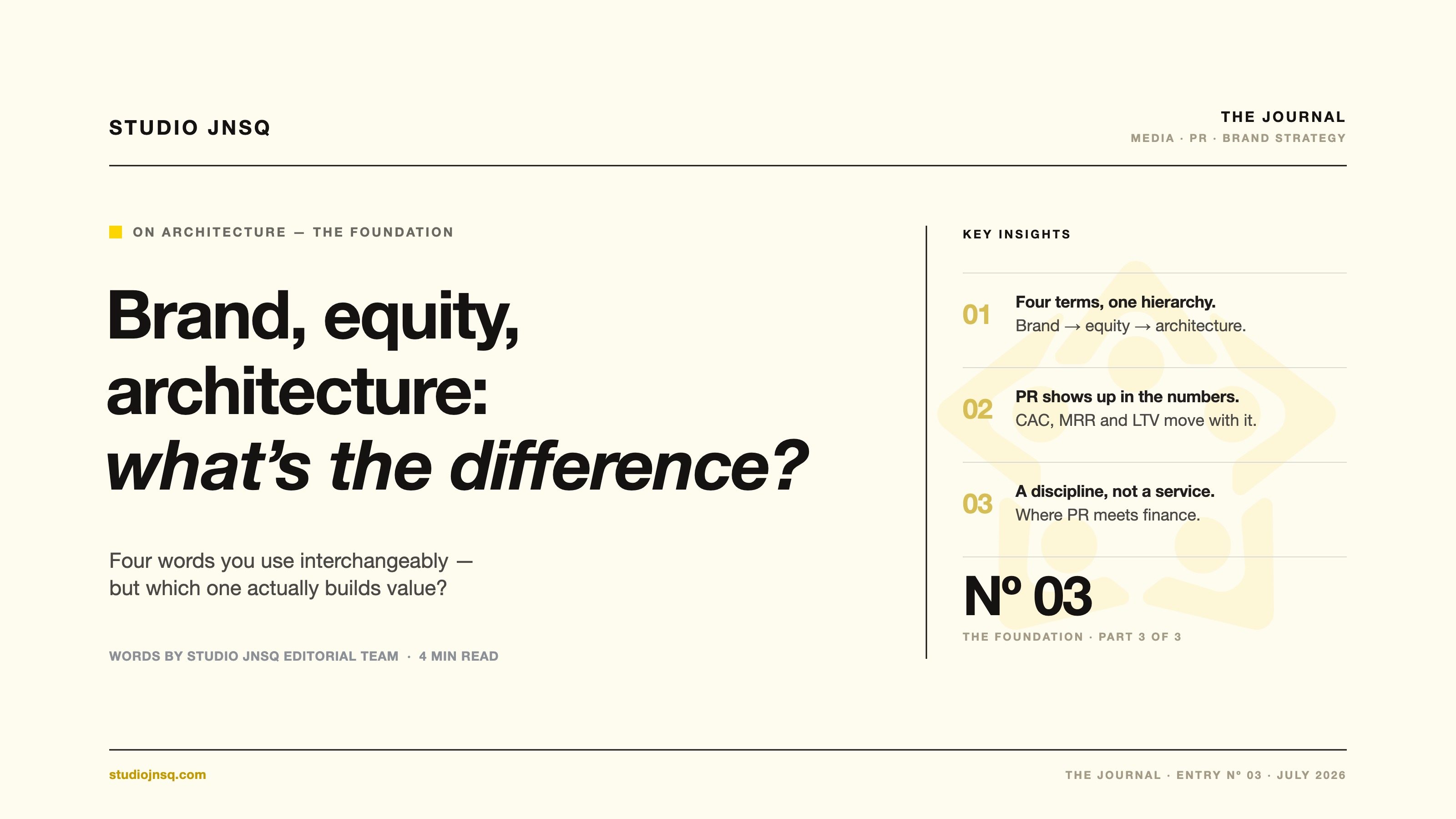
A brand is the entity. Brand equity is the value the market assigns to it. Brand architecture is how you organize offerings. Brand equity architecture is the system that makes all of it compound.
People have long confused media, marketing, advertising, and PR. The effects of PR are seen in numbers more than anywhere: CAC, MRR, LTV.
Brand equity architecture is a discipline, not a service. It sits where PR meets finance, and it is what Studio JNSQ practices.
This is the final installment of The Foundation. Over the past two editions, we covered what brand equity is and why identity is not the same as equity. This one draws the line between all four terms the market keeps confusing.
If you have ever sat in a meeting where someone used "branding" and "brand equity" interchangeably, or heard a consultant pitch "brand architecture" when what they were really selling was a logo refresh, you are not alone. These four terms get thrown around as if they mean the same thing, and the confusion is not just annoying; it is genuinely expensive. Businesses spend money solving the wrong problem because they misidentified which of these four things they needed to work on.
I have spent the better part of six years watching this confusion play out in real time, across industries from real estate to banking to agriculture. And what I can tell you is that once you understand the distinction between these four concepts, every decision about your brand, from where to spend your next dollar to how to prepare for an exit, gets significantly clearer.
What is a brand?
A brand is simply the entity that offers a product, a service, or a reputation. It is you, as the market knows you. Your name, your presence, the associations people carry when they hear your company mentioned. A brand is not good or bad on its own; it just is. Every business has one, whether they have been intentional about it or not. The question is never "do I have a brand?" because you do. The question is whether your brand is working for you or quietly working against you.
What is brand equity?
Brand equity is the value a business or brand holds after all assets have been appraised. It arises from your brand's perceived strength and value to the market and to competitors. Think of it this way: if two companies have identical revenue, identical margins, identical client lists, but one of them would sell for significantly more at exit, the difference in price is brand equity. It is not on the balance sheet, but every acquirer, investor, and sophisticated buyer is pricing it in.
According to Ocean Tomo, intangible assets including brand equity now account for 90% of the S&P 500's total market value. That number was 17% in 1975. The entire economy has shifted toward paying for what a name means rather than what a company makes, and most business owners have not recalibrated to that reality.
What is brand architecture?
Brand architecture is the process of organizing the offerings, sub-brands, and product lines within a company or group. If you run multiple brands, or if your company has different service tiers, or if you are deciding whether a new product should sit under your main brand or have its own identity, that is a brand architecture question. Think of how Procter & Gamble organizes Tide, Gillette, and Pampers under one corporate umbrella, or how Apple keeps everything under a single brand with product lines underneath. Those are brand architecture decisions.
Brand architecture matters, but it is structural. It tells you how to organize what you have. It does not tell you whether what you have is building value in the market.
What is brand equity architecture?
Brand equity architecture is the discipline that ensures a brand moves with clarity and harmony so it can venture into its higher arena well. It is the architecture behind brand equity itself; the strategic system that makes sure everything your business does, from finance to media to client relationships, works toward one specific goal with compounded consistency.
This is where I see most people get confused, so let me put it plainly. Brand equity architecture is not branding; it is not about your logo, your colors, or your visual identity, although branding is one component within it. It is not brand architecture; it is not about how you organize a portfolio of products. And it is not marketing or advertising. Brand equity architecture sits at the convergence of PR and finance, two fields that people have treated as separate for decades but that are deeply connected.
"People have long been neglecting PR in comparison to marketing, media, and advertising because it was not always measured in numbers," I often explain to clients. "People always assumed there was no way to measure it, but brand equity architecture says otherwise. The effects of PR are seen in numbers more than anywhere: CAC, MRR, LTV. A good brand equity from a good architecture of it results in lower customer acquisition cost, higher monthly recurring revenue, and therefore higher lifetime value; but also lower spend on paid media because the relationship and trust compounds, not getting wiped after every campaign."
Good brand equity architecture becomes apparent when the business finds inferences and equitable compromises so it can move toward its desired direction with speed. Smaller companies use it to get to profitability. Bigger companies use it to build a stronger case for a higher valuation on exit.
Why does the difference between branding and brand equity architecture matter to your business?
Because the problem you think you have and the problem you actually have are often different, and each of these four things addresses a different problem. If your visual identity is dated and confusing, you have a branding problem. If the market does not assign a premium to your name, you have a brand equity problem. If your product lines are cannibalizing each other, you have a brand architecture problem. But if everything looks right on the surface and yet your pricing power is flat, your clients keep leaving, and you cannot figure out why your competitor commands three times your rate, what you have is a brand equity architecture problem.
Our MAD™ diagnostic is built for people who want to understand where their specific brand stands in terms of market authority; it scores you across Demand, Credibility, Visibility, and Market Trust, with Branding as the centering point. If you are more focused on the business level, on how you are allocating time, money, and effort against the value you are actually building, the RVF™ diagnostic is where you start. Both are free, and both take about five minutes.
That wraps The Foundation. Next up, we begin The MAD™ Series, a five-part deep dive into the Market Authority Diamond™ and its four facets plus centering point. Part 1 drops on Sunday, July 13.
Can a business have strong branding but weak brand equity?
Yes, and it is more common than most people think. A beautifully designed brand with no market trust, no earned media presence, and no pricing power has strong branding and zero equity. The two are related, but they are not the same.
Do I need brand architecture if I only have one brand?
Not necessarily. Brand architecture becomes relevant when you are managing multiple brands, sub-brands, or product lines. If you are a single-brand business, your focus should be on brand equity architecture: making sure that one brand compounds value over time.
Is brand equity architecture a one-time project or ongoing?
It is ongoing. Brand equity architecture is a discipline, not a deliverable. It is the continuous strategic alignment of all parts of your business toward compounding trust and market value. The architecture gets built, then maintained and refined as the business evolves.