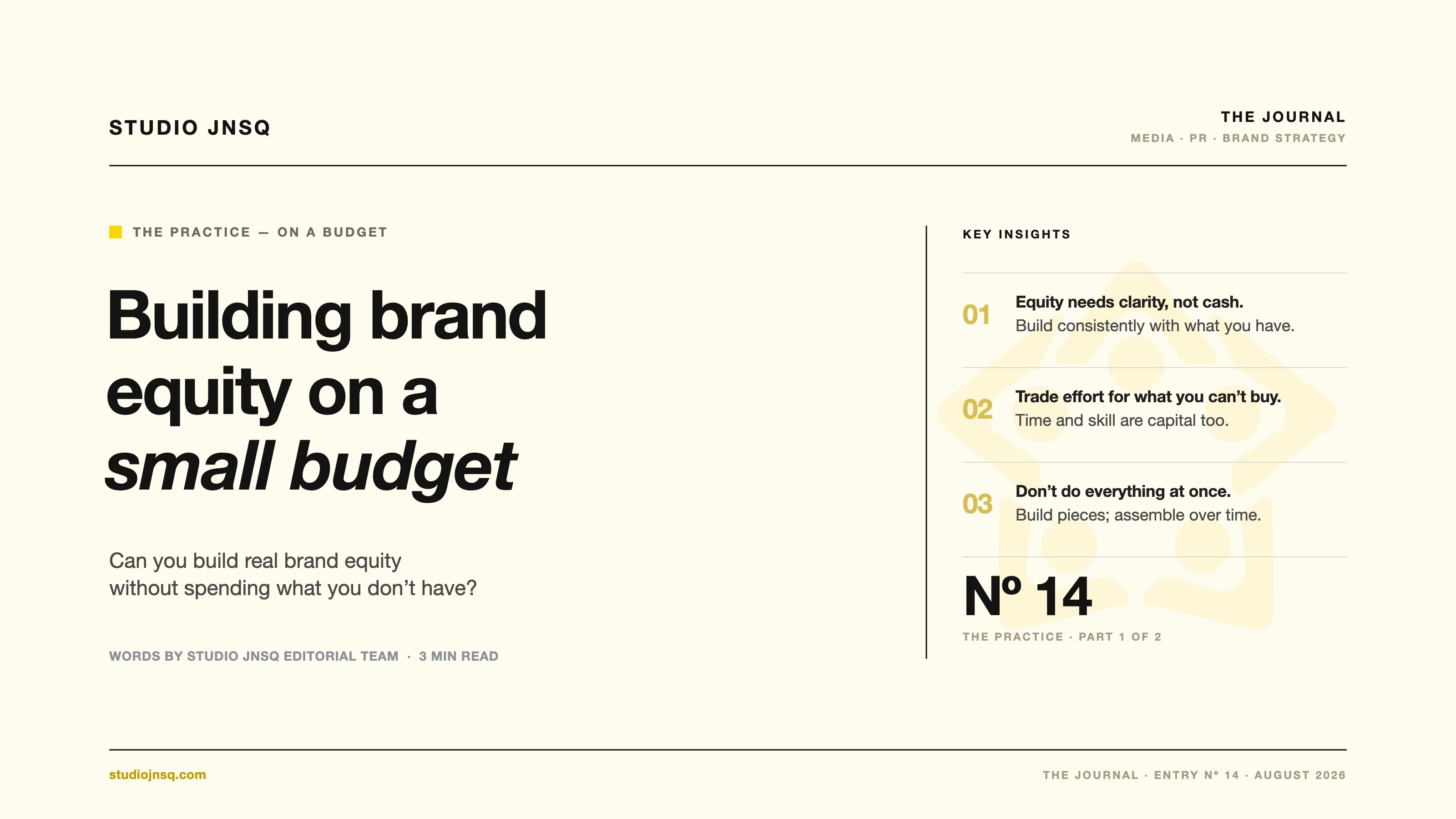
This is the first installment of The Practice, a two-part series on building brand equity in the real world with real constraints: limited budgets and founder-led brands that need to scale without losing what made them work.
You are running a $30,000-a-month business and the idea of brand equity architecture sounds like something for companies with marketing departments and six-figure brand budgets. It is not. Brand equity architecture is about making what you are already doing work harder, not about spending more. The firms we work with across every size and stage share one consistent pattern: the ones that build durable brand equity are not the ones with the biggest budgets. They are the ones who understand what they are building, make consistent decisions that reinforce that architecture, and resist the temptation to do everything at once.
Does building brand equity architecture have to be expensive?
No. What it needs to be is intentional. The architecture is the thinking: the clarity about what your brand stands for, who it serves, how it creates value, and how every touchpoint reinforces or undermines that. None of that requires money. It requires clarity, consistency, and the discipline to make decisions that align with the architecture you are building.
What expensive brand work usually buys is execution speed and production quality. You can get a premium website, a professional photo library, and a polished content program faster if you spend more. But the underlying architecture, the strategic decisions that determine whether all of that execution builds equity, does not come from the budget. It comes from the thinking. Kantar's research on brand equity measurement reinforces this: the brands that build sustainable equity are the ones that invest in meaning and differentiation, regardless of budget size.
A brand with a $500 budget and a clear architecture will build more equity than a brand with a $50,000 budget and no architecture.
What can you do right now with limited resources?
Start with what is already there. You have a positioning, even if it is not fully articulated. You have a delivery style, even if it is not documented. You have touchpoints, even if they are not designed. The first move is to audit what exists, find the gaps between what you are doing and what the architecture requires, and close the highest-leverage gaps first.
When crushed with lack of resources, think in exchanges and find equitable compromises. If you do not have the budget for a PR firm, you have the time to pitch journalists yourself. If you cannot afford a brand designer, invest in the strategic clarity that will make any designer's work more effective. If you cannot afford a full content program, write one strong piece a month that builds your authority on the terms you want to own. Deloitte's research on building trust shows that trust, the foundation of brand equity, is built through consistent, authentic behavior over time, not through budget size.
The other practical move is to focus limited resources on the facets of brand equity that have the highest leverage for your specific situation. This is what the MAD™ diagnostic reveals: where the gaps are, which ones are most affecting your market authority, and where a dollar or an hour of effort will do the most work.
How do you prioritize when you cannot do everything at once?
The single most important rule: build pieces and put them together. Brand equity is a structure, not a campaign. A structure is built in stages, with each piece reinforcing the others. A campaign is a burst of activity that produces short-term results and then has to be replaced.
Prioritize based on what your market most needs to trust you for. If you are selling consulting services, credibility is your most critical equity asset. If you are building a product company, visibility and demand need the most work. The MAD™ diagnostic maps this directly: it tells you which of the four facets and the centering point is your weakest link.
Avoid the trap of visible but low-equity activity: spending time and money on things that look like brand building but do not build the architecture. A rebrand that changes colors but not positioning. A content program that generates traffic but does not reinforce a clear point of view. Social presence that is active but unfocused. When the budget is tight, every action has to be architectural. Nielsen's research confirms: pulling back on long-term brand building increases acquisition costs and erodes future revenue, while consistent effort, even modest effort, compounds.
"It is not about doing all things all at once from the start, but building pieces and putting them together. A brand with clarity and consistency will outbuild a brand with budget and no direction, every time." — Jerico Lugo, Founder, Studio JNSQ
Up next in The Practice: Scaling a Founder-Led Brand Without Losing What Made It Work. Final installment drops Friday, August 7.