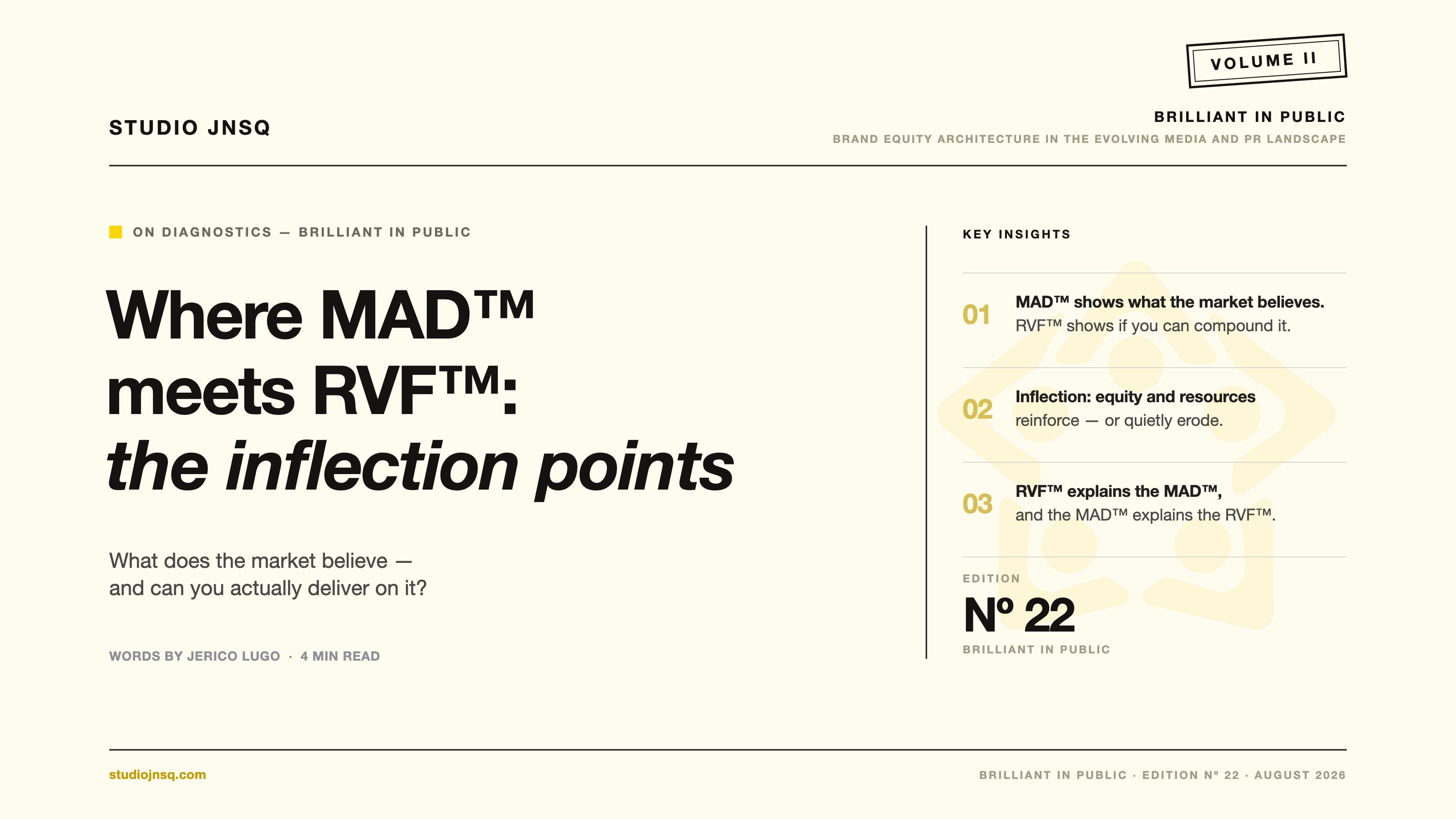
In the last edition, we covered how to read your MAD™ report and which scores to act on first. This one brings both diagnostics together: where the Market Authority Diamond™ and the Resource Value Formula™ intersect, and what happens at those inflection points. The final edition of this run. Most founders take one diagnostic. The ones who take both start seeing something neither diagnostic shows on its own: the inflection points where brand equity and resource allocation either reinforce each other or quietly cancel each other out. I have been through this process with enough founders now to recognize the pattern. You take the MAD™ and you understand where your brand stands in the market, which facets are strong, which are leaking, where the authority gaps are. Then you take the RVF™ and you see how your Time, Money, and Effort are being deployed. And somewhere in the comparison, something clicks. The MAD™ score that confused you suddenly makes sense in light of where your resources are going. The RVF™ imbalance that felt abstract suddenly has a clear downstream effect in the market.
Why do you need both MAD™ and RVF™ diagnostics for brand equity, not just one?
The MAD™ measures external reality: what the market believes about your brand, measured across four facets, with Branding as the centering point of market authority. It is a picture of your brand equity position as it exists in the minds of the market right now.
The RVF™ measures internal reality: how you are allocating your three core resources, Time, Money, and Effort, relative to the value you are generating. It is a picture of your operational architecture as it exists in the structure of your business right now.
These two pictures are connected, but the connection is not obvious until you hold them side by side. Your MAD™ Credibility score is partly a function of how much Time you are investing in thought leadership and relationship building, which shows up in your RVF™ Time allocation. Your MAD™ Demand score is partly a function of how much Money you are deploying into visibility, which shows up in your RVF™ Money allocation. Your MAD™ Market Trust score is partly a function of the Effort you are putting into delivery quality and client relationships, which shows up in your RVF™ Effort picture.
As I have observed with many founders: "Most founders who go through both diagnostics take the MAD™ first to understand what the market believes about their brand, then the RVF™ to understand whether their business model is structured to compound that belief into long-term value." That sequence is intentional.
What are the brand equity inflection points where MAD™ and RVF™ intersect?
An inflection point is a place where the two diagnostics either amplify each other or undercut each other. There are four I look for consistently.
The first is the Trust-Effort inflection. When RVF™ Effort is over-deployed in delivery and under-deployed in relationship building, MAD™ Market Trust tends to be lower than the quality of the work would predict. The founder is working hard, clients are satisfied, but the trust is not broadcasting outward. The fix is an Effort reallocation, not better delivery.
The second is the Credibility-Time inflection. When RVF™ Time is over-deployed in operations or client service and under-deployed in content, speaking, or media, MAD™ Credibility tends to lag behind the actual expertise. The market does not see the depth because the founder has not had the time to show it.
The third is the Demand-Money inflection. When RVF™ Money is over-deployed in tools and infrastructure and under-deployed in visibility, MAD™ Demand tends to be soft despite a technically strong operation. The business is well-run but not well-known.
The fourth is what I call the compound inflection: when all three resources are reasonably well-allocated and all four facets and the centering point MAD™ facets are above a functional floor, you are at the point where small, consistent investments compound into significant brand equity growth. That is the inflection point most founders are working toward.
What changes for brand equity when you see the full MAD™ and RVF™ picture?
The main thing that changes is that the work becomes strategic rather than reactive. When you can see both your market authority profile and your resource allocation profile, you stop making decisions based on what feels most urgent and start making them based on what moves both pictures in the right direction simultaneously.
It also changes how you measure progress. Instead of watching revenue numbers and wondering whether the strategy is working, you start watching the facet scores and the resource balances, which move earlier than the financial metrics. They are leading indicators, not lagging ones.
And it changes how you think about Brand Equity Architecture as a discipline. Brand equity architecture is the architecture of making sure all resource departments and all aspects of a brand work toward one specific goal with much less friction, finding equitable compromises, and compounded consistency. Seeing both diagnostics together is the first time most founders actually experience what that means in practice.
TRY THIS
Map your business on both frameworks right now. For MAD™: which facet is your strongest, and which is leaking? For RVF™: which trade are you in, and is it the right one for where your business actually is? Write both answers down. If your MAD™ shows strong scores but your RVF™ shows you are stuck in the wrong trade, your brand equity is real but your business structure is not built to sustain it. That is an inflection point, and knowing it exists is half the work.
That wraps this run of Brilliant In Public. Twenty-two editions of long-form thinking on brand equity architecture, media strategy, and the systems that turn profitable companies into valuable ones. More editions are coming. Thank you for reading.
You cannot optimize what you cannot see in stereo.
Running MAD™ without RVF™ tells you where you are weak but not why you are spending badly. Running RVF™ without MAD™ tells you where money goes but not whether it is building the equity that drives valuation. Together, they give you the only view that matters: whether your resource decisions are compounding market authority or just making noise.
- Smaller companies use the intersection to stop funding visibility when credibility is the blocker.
- Bigger companies use it to redirect capital toward the facets that drive acquisition premiums and pricing power.
"The gap between what the market believes and where you spend is where brand equity either compounds or dies quietly." — Jerico Lugo, MCIPR, Founder, Studio JNSQ
If you have not run both diagnostics yet, start with the MAD™ diagnostic to see where your market authority stands, then layer in the RVF™ diagnostic to see whether your allocation is aligned. The intersection is the work.
— Jerico Lugo, MCIPR